
Here's a number that surprises most people: roughly 64% of adults in the US report at least one adverse childhood experience, according to the CDC. That means the "inner child" isn't some fringe self-help idea. It's a real, common piece of most people's emotional lives, and it's why so many adults react to small moments with a reaction that feels way bigger than the moment itself.
In this guide, we'll walk through:
What an inner child actually is, in plain terms, not just Instagram language
Whether inner child therapy is legitimate and what the research actually supports
The modalities used, including IFS, EMDR, and CBT, and how they differ
What reparenting yourself looks like in real, practical terms
What to expect from your first appointment and how long healing tends to take
If you've ever felt an emotional reaction that didn't quite match the moment, this is for you.
What Is an Inner Child, Really?
We all encounter emotional pain in life, especially in childhood, when we're most vulnerable and least equipped to process it. When those early wounds go unhealed, they leave behind emotional fragments that show up later as reactions that seem disproportionate to what's actually happening.
In therapy, we call these fragments parts of the inner child: aspects of yourself that got frozen in time around a painful experience. Feeling devastated after being left off a group text might not reflect your adult reality. It might reflect a much older fear of being forgotten or unimportant.
Where Does the Idea Actually Come From?
This isn't a wellness trend with no clinical backing. The inner child concept draws on attachment theory and psychodynamic psychology, both of which look at how early relationships with caregivers shape adult patterns. Healing your inner child means confronting your emotional triggers, identifying what you actually need, and responding in ways that fit your adult values instead of your childhood fears.
Recognizing and naming these feelings is the first step. From there, the work is meeting those old, unmet needs with compassion instead of judgment.
If you keep circling back to the same old wound, trauma-informed individual therapy can help you understand where a reaction is really coming from and build new ways to respond.
Book a free 15-minute consultationIs Inner Child Therapy Actually Legitimate?
Fair question. Inner child language can sound like self-help fluff, but the work underneath it isn't.
What Does the Research Actually Support?
The CDC estimates that preventing adverse childhood experiences could reduce adult depression by as much as 78%. That's not a small number, and it's exactly why addressing childhood wounds directly, rather than managing symptoms indefinitely, matters clinically.
Inner child work isn't its own standalone license or licensed modality. It's a lens that gets applied inside real, evidence-based therapies, most often Internal Family Systems, EMDR, and psychodynamic talk therapy. A good therapist doesn't just have you talk to an imaginary child and call it done. They use structured techniques inside a modality with actual clinical grounding.
What It Isn't
It isn't a substitute for a licensed mental health professional if you're managing a diagnosed condition.
It isn't about blaming your parents or staying stuck in the past.
It isn't a one-session fix. Healing is a process, not a single insight.
How does inner child therapy work?
It works by helping you notice when a present-day reaction is actually an old, unmet childhood need showing up. A therapist helps you identify the pattern, understand where it started, and practice meeting that need in healthier ways now, often using IFS, EMDR, or psychodynamic techniques.
What Is Childhood Trauma Therapy?
Grief isn't only about losing a loved one. It can also come from unmet needs and emotional wounds from childhood. If you experienced neglect, emotional abandonment, or invalidation growing up, you might be carrying a grief that's never been fully acknowledged.
Childhood trauma therapy is the broader clinical work of processing that grief. It looks at losses that aren't always obvious: emotional neglect, lack of validation, or unmet needs for safety and connection. Unlike the grief after a death, these losses are subtle but just as real.
What Do Clients Usually Describe?
Adults seeking therapy for childhood trauma often describe:
A pervasive feeling of not being enough, regardless of what they accomplish
A sense of emptiness they can't quite explain
These feelings usually trace back to early experiences where emotional needs weren't met, leading to a kind of internalized grief that's hard to name until someone helps you see it.
A core part of this work is what we sometimes call compassionate witnessing: being present with someone's pain without judgment. That presence alone helps a person feel seen, which is often the first real step toward healing.
What Modalities Are Used in This Work?
Inner child and childhood trauma work isn't one single technique. It gets woven into several established therapeutic modalities, and knowing the difference helps you understand what a session might actually look like.
Internal Family Systems (IFS)
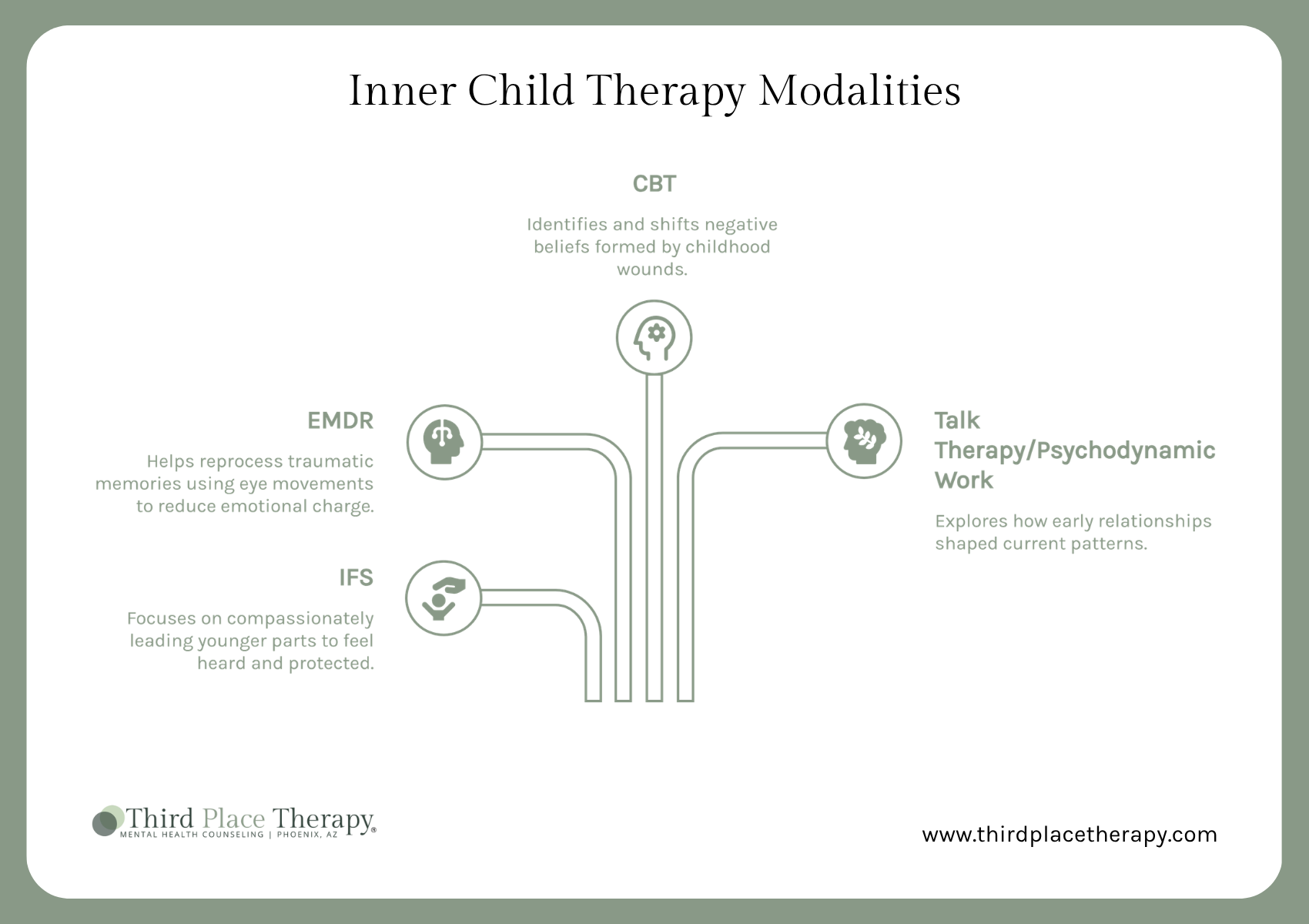
IFS views your mind as made up of different "parts," including younger, wounded parts still holding old pain. According to the IFS Institute, the goal is helping your core Self lead with compassion so those younger parts feel heard and protected instead of exiled or ignored.
EMDR (Eye Movement Desensitization and Reprocessing)
EMDR helps the brain reprocess stuck traumatic memories using guided eye movements, reducing the emotional charge a memory carries. It's especially useful when a specific childhood memory keeps resurfacing with the same intensity every time.
Cognitive Behavioral Therapy (CBT)
CBT looks at the beliefs a childhood wound left behind, things like "I have to be perfect to be loved," and works to identify and shift those beliefs directly. It's more structured and present-focused than IFS or EMDR.
Talk Therapy and Psychodynamic Work
Traditional talk therapy explores how early relationships with caregivers shaped your current patterns. Psychodynamic therapy in particular is well suited to inner child work because it's built around exactly this kind of early-experience exploration.
Which One Is Right for You?
There isn't one correct modality. IFS tends to fit people who want a structured way to relate to different internal parts. EMDR fits well when a specific memory feels stuck. CBT fits when the goal is to change a specific belief pattern quickly. Many therapists, including ours, blend approaches based on what a client actually needs from session to session.
What are inner child wounds and what causes them?
Inner child wounds are the emotional injuries left over from unmet needs growing up, things like neglect, harsh criticism, or a home where it wasn't safe to feel safe expressing big emotions. The inner child may carry these quietly for years before they show up as adult patterns like people-pleasing or self-sabotage.
Reparenting Yourself: What It Looks Like
Once you've identified a wounded or forgotten part of your inner child, reparenting is the practical next step. Here's what that can look like:
Do a Childlike Activity
Pick an activity your younger self would have loved: coloring, swinging at the park, dancing to a song you loved as a kid. Let yourself fully be in it. Notice what emotions come up as you visualize your younger self right there with you.
Look at a Photo of Your Younger Self
Find a childhood photo from around the age of the part you're working with. Study the expression, the posture. Let yourself feel compassion, or even sadness, for that version of you. Imagine what they'd feel seeing you look at them with love.
Have a Conversation With Your Inner Child
In a quiet moment, close your eyes and picture your younger self in a hard memory. Pause the scene. Approach with curiosity instead of judgment. Ask what they need. Offer reassurance and a comforting presence.
Write a Letter to Your Inner Child
Some people find it easier to write than to visualize. Write a letter to your younger self acknowledging what they went through and what you wish someone had told them. Then, if it feels right, write one back from your inner child to you.
Sometimes these practices bring tears. Sometimes they bring a kind of quiet peace. Both are signs that healing is happening.
What Are Signs Your Inner Child Is Activated?
Not every strong reaction means your inner child is activated, but certain patterns show up often enough that they're worth naming. Common signs include:
People-pleasing: Trouble saying no or apologizing for things that aren't your fault.
Fear of abandonment: Panic over small signs of distance in a relationship, or the opposite, pushing people away first.
Self-sabotage: Unconsciously derailing something good right as it starts going well.
Emotional overreaction: A response that feels much bigger than the situation calls for.
Numbing: Using food, scrolling, or busyness to avoid a feeling instead of naming it.
These are symptoms of childhood trauma in adults rather than character flaws. They're old coping strategies that made sense once and just haven't caught up to your adult life yet.
If these patterns keep showing up in your relationship
Childhood wounds shape adult relationship patterns more than most people realize. Relationship therapy can help you and your partner understand what's really driving the pattern.
Book a free 15-minute consultationWhat are signs of an unhealed inner child?
Common signs include chronic people-pleasing, an intense fear of abandonment, self-sabotage right when things go well, and emotional reactions that feel much bigger than the situation calls for. These patterns usually point to old, unmet needs rather than a character flaw.
What Happens in Your First Appointment?
If you're picturing something intense right out of the gate, that's not how this usually goes. Your first appointment is mostly about safety and history, not diving straight into painful memories.
What Should You Expect?
A conversation about what's bringing you in and what you're hoping changes
Some background on your history, at whatever pace feels okay to share
A sense of your therapist's approach and whether it feels like a fit
No pressure to relive anything before you feel ready
Good inner child and trauma work happens gradually. A good therapist paces things so your nervous system stays regulated enough to actually process what comes up, instead of just re-experiencing it.
How Long Does This Actually Take?
There's no single timeline, but there are real benchmarks worth knowing. The American Psychological Association notes that, on average, 15 to 20 sessions are needed for about half of clients to see clinically significant improvement.
Childhood trauma work often runs on the longer end of that range, since it involves patterns built over years, not weeks. That's not a discouraging number. It's a realistic one, and it means giving up after two or three sessions isn't a fair test of whether this works.
Can you heal your inner child on your own?
To some extent, yes. Journaling, reparenting exercises, and building self-compassion can help you nurture your inner child and start to feel safe in your own emotions. For deeper wounds, especially ones tied to trauma, working with a therapist tends to get you further, faster.
Healing Childhood Wounds: Where This Work Leads
Insight alone doesn't lead to healing. Experience does. And few experiences matter more than finally offering your younger self the care they didn't get the first time around.
If you notice these patterns showing up in how you set (or don't set) healthy boundaries or how you navigate relationship dynamics, that's not a coincidence. Childhood wounds and adult relationship patterns are almost always connected.
At Third Place Therapy, we believe your younger self deserves the love and healing that are possible now, even if they weren't available then. If you're ready to explore this work, in person in Phoenix or online across Arizona, reach out today. You don't have to do this alone.
