
Baby Blues vs. Postpartum Depression: How to Tell the Difference
The days after your baby is born can feel like a lot. Joyful, yes. But also overwhelming, tender, raw, and sometimes really hard to explain to anyone who isn't living it.
Crying in the shower one hour and feeling okay the next. Loving your baby fiercely while also feeling strangely disconnected. Wondering if what you're feeling is normal, or if something more is going on.
Many new mothers experience some version of the “baby blues” in the first week or two after childbirth. But sometimes what feels like the baby blues doesn't go away. And that’s when it becomes especially important to understand the difference between baby blues and postpartum depression.
Here's what we cover:
What the baby blues actually are
What postpartum depression looks like and how it differs
The postpartum depression timeline
Risk factors worth knowing about
Postpartum psychosis vs. postpartum depression
Treatment options and when to seek help
If you're in Arizona and unsure which one you're dealing with, we're here to help you figure it out.
Postpartum depression can affect anyone who has given birth. Partners and adoptive parents can also experience depression, anxiety, overwhelm, or disconnection after a baby arrives, and they deserve support, too.
What Are the Baby Blues?
The baby blues are a brief, normal emotional response to the massive hormonal shift that happens after giving birth. When a baby is born, estrogen and progesterone levels drop sharply and suddenly. That drop alone is enough to cause significant emotional ups and downs, even in people who have never experienced depression or anxiety before.
When do the baby blues typically start, and how long do they last?
The baby blues typically start within 2 to 3 days after giving birth, peak around day 4 or 5, and resolve on their own within two weeks. Baby blues usually do not require clinical treatment, but support, rest, food, sleep, and check-ins matter. If symptoms feel intense, unsafe, are getting worse, or last beyond two weeks, reach out to a health care provider.
What Baby Blues Feel Like
Around 70 to 80 percent of new mothers experience the baby blues, according to the South Dakota Department of Health. Symptoms tend to include:
Mood swings: Emotions that shift quickly, sometimes without a clear reason.
Tearfulness: Crying more than usual, often over small things.
Irritability: Feeling on edge or short-tempered with people you love.
Feelings of sadness: A low mood that comes and goes throughout the day.
Physical exhaustion: Bone-deep tiredness that makes everything feel harder.
Feeling overwhelmed: Struggling to keep up with the demands of caring for a new baby.
The key thing about the baby blues is the word "blues." The symptoms are real and uncomfortable, but they tend to come and go rather than settle in as a constant weight. They peak around days 3 to 5 after birth and resolve on their own within two weeks after childbirth.
Why Are Baby Blues Worse at Night?
This is something we hear often. Nighttime tends to amplify baby blues symptoms because sleep deprivation is at its worst, the house is quiet, and there's less distraction from difficult feelings. Hormonal fluctuations also tend to peak in the evenings. If the nights feel unbearable, that's worth noting. But it doesn't automatically mean something more serious is happening.
What Is Postpartum Depression?
Postpartum depression is not a more intense version of the baby blues. It's a different condition entirely. PPD is a clinical mood disorder, and unlike the baby blues, it doesn't resolve on its own within a couple of weeks. It persists, often deepens, and left untreated, it can significantly interfere with your ability to function, bond with your baby, and take care of daily tasks.
Postpartum depression can happen after a first baby, a second baby, or a later birth, even if you did not experience it before. Mothers who experienced pregnancy loss, infertility, a NICU stay, emergency delivery, or a frightening medical experience may also be more vulnerable to postpartum depression, anxiety, or trauma symptoms.
Perinatal depression is a broader term that includes depression occurring during pregnancy and after birth. The American College of Obstetricians and Gynecologists (ACOG) recommends that all pregnant and postpartum women be screened for depression and anxiety. And yet many mothers still slip through without being asked how they're really doing.
Symptoms of Postpartum Depression
The symptoms of postpartum depression go further than sadness and tiredness. They may include persistent feelings of emptiness or hopelessness, inability to enjoy things that once felt good, difficulty bonding with your new baby, withdrawing from people you love, trouble sleeping even when the baby is asleep, and, in more severe cases, thoughts of harming yourself or your baby.
When should you seek professional help for baby blues or postpartum depression?
Seek help if your symptoms last longer than two weeks, are getting worse rather than better, or are interfering with your ability to care for yourself or your baby. Don't wait until you're at a breaking point. Early support leads to faster recovery.
What Partners and Loved Ones Should Watch For
The people closest to a new parent are often the first to notice that something isn't right. Sometimes the person experiencing it is too exhausted, too ashamed, or too deep in it to see it clearly.
If you're a partner, family member, or close friend, here's what to watch for:
Persistent sadness or crying that doesn't seem to be lifting after the first couple of weeks
Withdrawal from people they love, including the baby
Difficulty functioning with daily tasks like eating, sleeping, or basic self-care
Expressing feelings of worthlessness or saying they're a bad parent
Seeming detached from the baby or showing little interest in feeding or holding them
Irritability or anger that feels out of proportion and constant
If you notice these signs, don't wait for them to bring it up. Name what you're seeing with kindness, not alarm. Something like: "I've noticed you seem really low lately. I'm not going anywhere, and I think it might help to talk to someone."
Encouraging them to contact a health care provider or a perinatal mental health therapist is one of the most important things you can do.
Not sure which one you're experiencing? That uncertainty itself is worth a conversation. Reach out to Third Place Therapy, and we'll help you make sense of it together.
Baby Blues vs. Postpartum Depression: Key Differences
The differences between the two come down to three things: timing, intensity, and impact on daily life. Here's a clear side-by-side look:
| Baby Blues | Postpartum Depression | |
|---|---|---|
| When it starts | Within a few days of birth | Within weeks or months of birth |
| How long it lasts | Up to 2 weeks | Weeks to months without treatment |
| Severity | Mild, comes and goes | Persistent, often worsening |
| Daily functioning | Generally unaffected | Often significantly impaired |
| Resolves on its own? | Yes | Rarely without treatment |
| Treatment needed? | Usually not | Yes |
The Line Between the Two
The clearest way to tell the difference between baby blues and PPD is to watch the two-week mark. If you're still struggling significantly two weeks after birth, or if things are getting worse rather than better, that's when the baby blues become less likely as an explanation.
It's also worth knowing that postpartum depression doesn't always start right after the baby is born. Some new mothers experience postpartum depression for the first time several weeks or even months after giving birth. So a difficult third or fourth month doesn't mean you "missed the window." You didn't.
The Postpartum Depression Timeline
Understanding the postpartum depression timeline helps both new parents and the people around them know what to look for and when.
When Does PPD Typically Start?
Most cases of postpartum depression begin within the first few weeks after birth, though PPD can develop at any point during the first year postpartum. Some mothers also experience what's called perinatal depression, meaning symptoms begin during pregnancy and continue after childbirth.
What causes baby blues and postpartum depression?
Baby blues are caused primarily by the sharp drop in estrogen and progesterone after birth. Postpartum depression has a broader set of causes, including hormonal changes, sleep deprivation, a history of depression, stressful life events, lack of support, and birth trauma. It's rarely one thing alone.
How Long Does PPD Last?
Without treatment, postpartum depression can last for months. Depression can last well beyond the first year if it isn't addressed. With treatment, including therapy, medication, or both, many people begin to feel meaningfully better within weeks of starting treatment, though the timeline depends on symptom severity, support, medication needs, and individual circumstances. The research is encouraging: treatment can help, and the sooner it starts, the better the outcomes tend to be.
Antidepressants, specifically selective serotonin reuptake inhibitors (SSRIs), are commonly used to treat postpartum depression and take a few weeks to reach full effect. Many are safe to take while breastfeeding. Your health care provider can walk you through the options based on your situation.
What Increases the Risk of Postpartum Depression?
Anyone who gives birth can develop postpartum depression. But certain factors increase the risk, and knowing them helps with early identification and planning.
A personal history of depression or anxiety: Including previous episodes of PPD after an earlier birth.
Stressful life events: Financial strain, relationship difficulties, loss, or significant life changes around the time of the birth of a baby.
Lack of support: Feeling isolated or without reliable people to help with the new baby.
Hormonal changes after birth: The dramatic drop in estrogen and progesterone affects every new mother, but some people are more vulnerable to these hormonal shifts than others.
Birth trauma or complications: A difficult delivery or unexpected medical events can increase emotional vulnerability.
A history of trauma: Unresolved past trauma often surfaces or intensifies during the postpartum period.
This list isn't meant to create anxiety about what might happen. It's meant to give you permission to take your mental health seriously before and after your baby is born, and to ask for help early rather than waiting until things feel unbearable.
What self-care steps or coping mechanisms can help with baby blues?
Rest when you can, accept help when it's offered, eat regularly, limit alcohol, and stay connected to people you trust. For baby blues, these steps often help symptoms pass more quickly. For postpartum depression, self-care alone isn't enough. Professional support makes a real difference.
Postpartum Psychosis vs. Postpartum Depression
Postpartum psychosis is not the same as postpartum depression, and it's important to understand the difference between the two. Postpartum psychosis is rare, affecting approximately 1 to 2 in every 1,000 mothers, but it is a psychiatric emergency that requires immediate medical attention.
Signs of Postpartum Psychosis
Unlike postpartum depression, which develops gradually, postpartum psychosis typically comes on very quickly, often within the first two weeks after giving birth. Signs include hallucinations, delusions, severe confusion, rapid mood swings that feel extreme even compared to PPD, paranoia, and, in serious cases, thoughts of harming yourself or your baby.
If you or someone you love is showing signs of postpartum psychosis, call 911 or go to the nearest emergency room. You can also call or text 988 to reach the Suicide and Crisis Lifeline, available 24/7. If there is immediate danger, do not wait for a therapy consultation or hotline callback.
Why PPD Doesn't Become Psychosis
One fear we sometimes hear from mothers experiencing PPD is that it will escalate into something more severe. Postpartum depression and postpartum psychosis are different conditions. Having PPD does not mean you are destined to develop psychosis, but any hallucinations, delusions, severe confusion, paranoia, or thoughts of harm should be treated as an emergency.
Treatment for Postpartum Depression
Postpartum depression is highly treatable. Most new mothers who seek help respond well, and many begin to feel like themselves again within a few months. That's not a small thing. It means there is a real path forward.
What Treatment Can Look Like
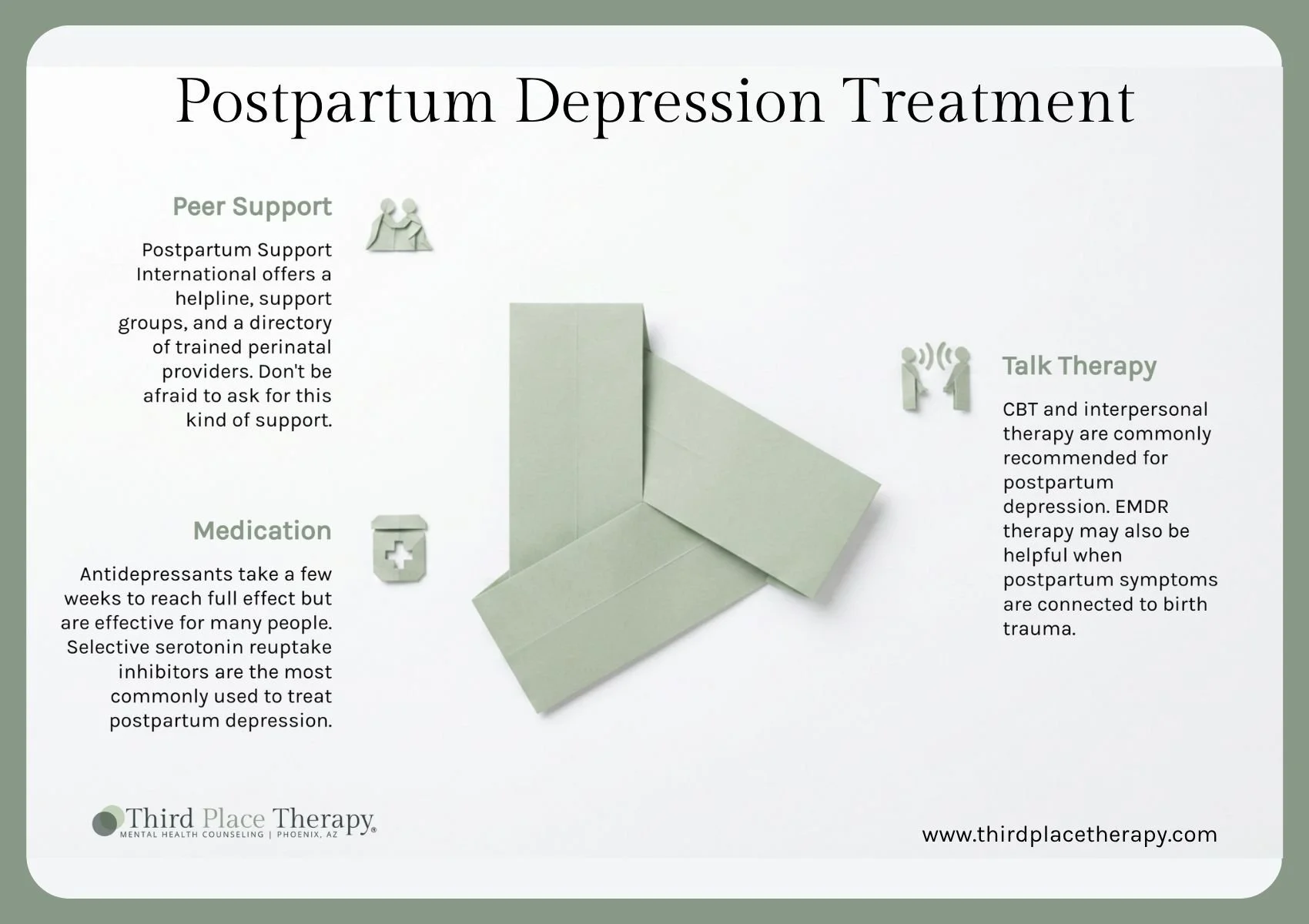
The American Academy of Pediatrics recommends universal screening for perinatal depression, and treatment can include talk therapy, medication, peer support, or a combination of all three.
Talk therapy: CBT and interpersonal therapy are commonly recommended for postpartum depression. EMDR therapy may also be helpful when postpartum symptoms are connected to birth trauma, medical trauma, or unresolved earlier trauma.
Medication: Antidepressants take a few weeks to reach full effect but are effective for many people. Selective serotonin reuptake inhibitors are the most commonly used to treat postpartum depression, and several are compatible with breastfeeding. In some cases, providers may also discuss newer postpartum depression medications, depending on symptoms, breastfeeding, medical history, and access.
Peer and community support: Postpartum Support International offers a helpline, support groups, and a directory of trained perinatal providers. Don't be afraid to ask for this kind of support. It can make a significant difference, especially when combined with professional treatment.
The Office on Women's Health also provides resources and a 24/7 support line for pregnant and postpartum women at 1-833-TLC-MAMA.
What to Say When You Reach Out
You can keep it simple: “I had a baby recently, and I don’t feel like myself. I’m feeling sad, anxious, numb, or scared, and I think I need support.” You don’t need the perfect words. A good provider will know what questions to ask next.
What Happens If PPD Is Left Untreated
Left untreated, postpartum depression doesn't just affect the mother. Studies show that untreated PPD reduces a mother's sensitivity and responsiveness to her infant's needs, which can negatively affect the child's socio-emotional, cognitive, and motor development in the first year of life. Infants of mothers with untreated depression also show reduced expressive language skills and score lower on cognitive assessments. And partners aren't immune either. Research consistently finds that perinatal depression in one parent increases depression risk in the other.
Getting help isn't just for you. It's for your whole family. Mental health professionals who specialize in perinatal care understand this, and it shapes how we approach treatment.
You Deserve Support Too, Not Just Your Baby
At Third Place Therapy, we work specifically with new mothers and birthing parents navigating the postpartum period, including those trying to figure out whether what they're experiencing is the baby blues, postpartum depression, postpartum anxiety, or something they can't quite name yet.
Our approach is trauma-informed, which means we ask "what happened to you?" rather than "what's wrong with you?" We work with the whole picture, not just the symptoms.
We offer in-person therapy in Phoenix and online therapy throughout Arizona. We know you have a new baby at home, and we've built our practice to accommodate that reality.
It's normal to feel uncertain about reaching out. It's normal to wonder if you're "bad enough" to deserve help. You don't have to be at a breaking point to talk to someone. And if you are at a breaking point, that's even more reason to call.
Reach out to schedule a consultation. We're here whenever you're ready.
