
Therapist for New Moms: What to Look for in a Postpartum Specialist
You posted the smiling nursery photo. You also cried in the shower this morning and didn't tell anyone why. Both of those are true, and they can sit right next to each other without either one canceling the other out.
Nobody warns you that motherhood can feel like grief and joy sharing the same breath, or that you can count your baby’s fingers and toes with total devotion and still not recognize the person staring back in the mirror.
We wrote this for the mom reading it one-handed at 2 a.m., and for the one who looks completely fine from the outside and is unraveling on the inside. If you've started searching for a therapist for new moms, you've probably already sensed that something needs to change. Here's what we'll walk through together:
Why struggling doesn't mean you're failing, even if you look "fine" from the outside
What postpartum depression therapy actually looks like, and who it's for
The signs new moms often miss, including intrusive thoughts nobody talks about
What a first session feels like, and how telehealth removes the biggest barriers
What to look for in a postpartum depression counselor, and how to get started

You Can Love Your Baby and Still Be Struggling
So many of the new moms we work with are the ones everyone assumes are doing great. The friend who always shows up with a diaper bag packed and a smile on. The mom who answers "fine" every time someone asks how she's doing. Underneath, she might be running on empty, disconnected from her own body, or terrified of thoughts she'd never say out loud.
That gap between how you look and how you feel is exhausting. It's also incredibly common. If you're a high-achieving mom who feels ashamed that you haven't "gotten it together" yet, please hear this: struggling after a baby is not a character flaw. It's a response to one of the biggest life transitions a person goes through.
This is true whether this is your first baby or your third, whether your birth went smoothly or left you with real trauma, and whether you're the one who gave birth or the partner adjusting alongside her.
Partners struggle too. In fact, research on paternal perinatal mental health suggests that close to 1 in 10 dads experience depression themselves, often peaking a few months after birth, and it usually goes unrecognized because nobody thinks to ask.
You're allowed to need support. You're allowed to ask for it before things feel unbearable.
What Is Postpartum Depression Therapy and Is It Right for You?
If you've searched postpartum depression therapy online, you're probably somewhere between "something feels off" and "I need to talk to someone." Both are good reasons to reach out.
Postpartum therapy, sometimes called perinatal mental health therapy, supports the full spectrum of experiences that can come up during pregnancy and after birth. That includes the baby blues, postpartum depression, postpartum anxiety, birth trauma, and postpartum OCD. It's also for moms recovering from infertility or pregnancy loss on their way to becoming a parent, and for anyone whose path into motherhood didn't look the way they expected.
CDC research shows that roughly 1 in 8 women reported postpartum depressive symptoms after a live birth, which adds up to hundreds of thousands of mothers every year. You are genuinely not alone in this.
You don't need a diagnosis to benefit from postpartum therapy. If something feels harder than it should, that's reason enough to reach out.
What are the red flags for postpartum depression?
Persistent sadness that doesn't lift, difficulty bonding with your baby, intrusive or scary thoughts, rage that feels out of character, and withdrawing from people you love are all signs worth taking seriously. If you're having thoughts of harming yourself or your baby, reach out for help immediately.
Signs You Might Benefit From Seeing a Postpartum Depression Therapist
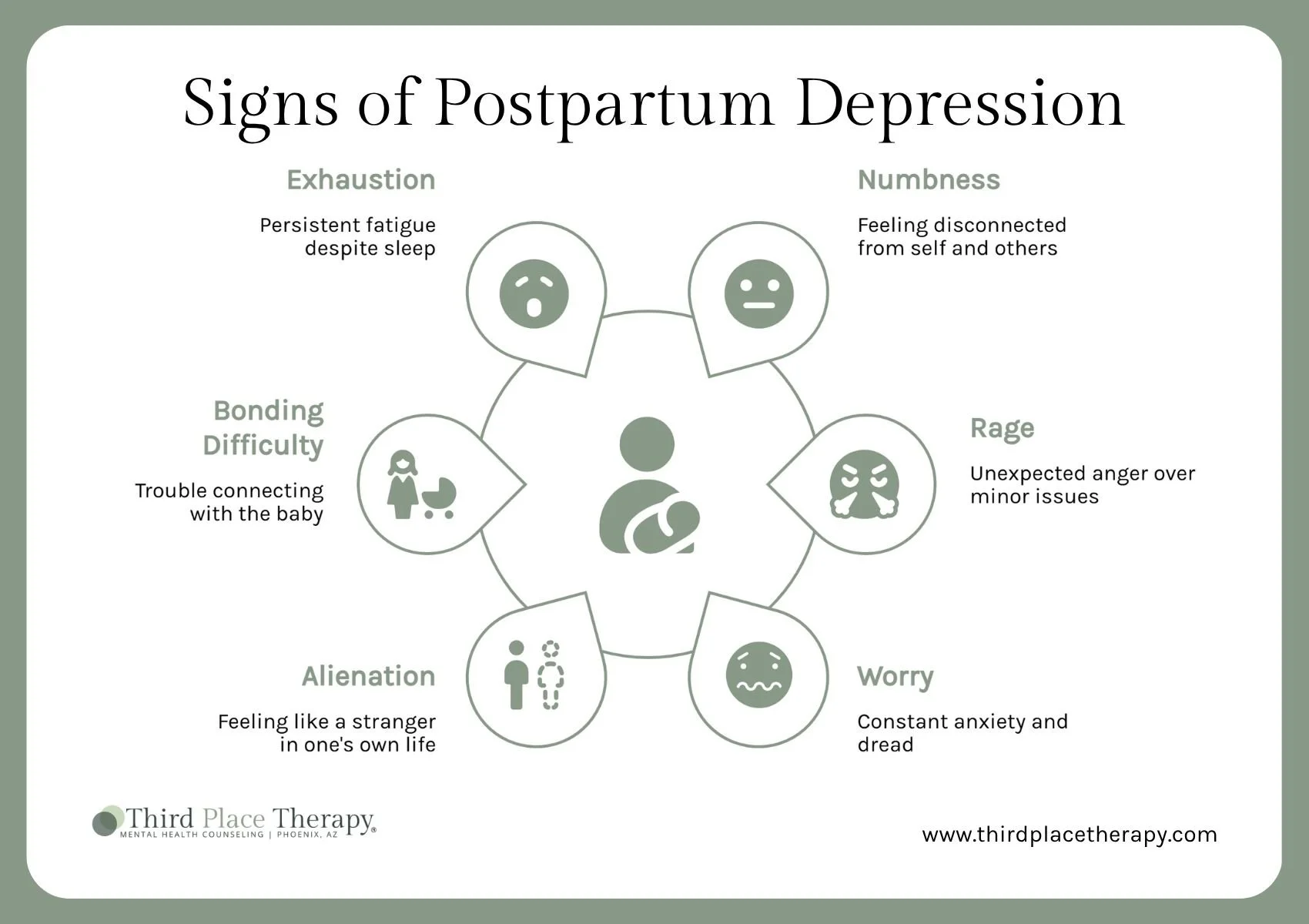
A postpartum depression therapist can help with more than sadness. Some of the less obvious signs we see in our nonjudgmental space include:
Feeling numb or disconnected from your baby, your partner, or yourself
Rage that surprises you, especially over small things
Constant worry or a sense of dread that won't lift
Feeling like a stranger in your own life, or grieving who you were before
Difficulty bonding, which can feel frightening and shameful to admit
Exhaustion that sleep doesn't seem to fix
What About Postpartum OCD and Intrusive Thoughts?
This is the part almost nobody talks about, and it's exactly why we want to. Many new moms experience sudden, unwanted thoughts about something terrible happening to their baby. Some describe a "what if" spiral they can't turn off.
Postpartum Support International notes that estimates of how many new parents experience postpartum OCD vary widely, largely because the condition remains understudied and under-reported, which tells us these experiences are far more common than the silence around them suggests.
Having these thoughts does not mean you would ever act on them, and it does not mean you're a dangerous parent. It's a recognized, treatable experience, not a reflection of your character.
What type of therapist is best for postpartum depression?
Look for a therapist with specific perinatal mental health training, ideally the PMH-C credential, and a trauma-informed, nonjudgmental approach. Many moms benefit from therapists who use EMDR or IFS alongside talk therapy, especially when birth trauma or identity shifts are part of the picture.
What Does Therapy for New Moms Actually Look Like?
We know the question underneath the question: what actually happens in a session? Nothing scary. Your first appointment is a conversation, not an evaluation.
We'll ask about your pregnancy, your birth, your history, and what's weighing on you right now. There's no homework due in week one. Sessions are tailored to where you are, not a script we run for every mom.
Depending on what's coming up for you, therapy for parents at our practice may draw from a few evidence-based approaches:
EMDR therapy, often used for birth trauma or a difficult delivery that's still replaying in your mind.
Internal Family Systems (IFS), which is especially useful for the identity shifts of matrescence, the psychological process of becoming a mother.
CBT and general talk therapy, for building coping strategies for the day-to-day overwhelm of a new baby
What to Expect in Your First Therapy Session as a New Mom
Your first session usually runs 50 to 60 minutes, and it's more conversation than clinical intake. Expect questions about your pregnancy, your delivery, your support system, your sleep, and what's been weighing on you since the baby arrived.
We'll also ask about any history of depression and anxiety, prior grief and loss, or relationship issues that might be part of the picture, since context matters more than checklists.
Everything you share is confidential, protected under the same standards as any mental health counseling relationship, and stays between you and your therapist unless there's an immediate safety concern.
Just as important is what won't happen. Your therapist will not judge you, hand you a list of generic advice, or rush you toward a diagnosis. Seeking help for postpartum mood or postpartum depression and anxiety should feel like compassionate care from the very first conversation, not another performance review.
Telehealth vs. In-Person: Which Option Works for New Moms?
Getting to an in-person appointment with a new baby is its own stressor: no childcare, unpredictable feeding schedules, and not enough energy to leave the house.
Online counseling helps solve that. We offer telehealth therapy across all of Arizona, so you can have a session during nap time, in your own space, with your baby nearby if needed. No commute required.
If you're in the Phoenix area and prefer face-to-face, we also offer in-person postpartum therapy sessions. Either way works. What matters is that you actually get the support, not which option you choose to get there.
How Long Does Postpartum Therapy Take to Work?
Every mom's timeline is different, and we won't promise a fast fix. What we can tell you is that many clients notice some relief within the first few sessions, even while deeper healing takes longer.
That tracks with the broader research: with appropriate treatment and support, depression is treatable. Recovery is a real, realistic outcome. It’s a process of returning to yourself, not a race to meet a deadline.
What is the hardest month of postpartum?
Many moms report the first three months as the hardest, as sleep deprivation, hormonal shifts, and the transition into parenthood are all at their peak. That said, everyone's experience is different, and struggles can surface at any time in the first year.
Support for Birth Trauma and Traumatic Delivery
A difficult delivery doesn't have to involve a medical emergency to leave a lasting mark. Emergency interventions, feeling unheard during labor, a NICU stay, or simply losing control over what was supposed to be your birth plan can all show up later as birth trauma. It's one of the most overlooked mental health concerns in the postpartum period, and one we see often among postpartum mothers seeking therapy for pregnancy and postpartum support.
EMDR (Eye Movement Desensitization and Reprocessing) is considered the evidence-based treatment of choice for birth trauma. It helps the nervous system process what happened without needing you to relive every detail out loud, session after session.
If certain memories, sounds, or hospital smells still bring you right back to your delivery room, that's not something to push through alone. It's a sign perinatal and postpartum therapy could help, whether the trauma is fresh or years old.
What to Look for in a Postpartum Depression Counselor
Not every professional counselor has training in perinatal mental health, so it's worth asking a few questions before you book:
Do they have specific training in postpartum or perinatal care, such as the PMH-C credential?
Do they use a trauma-informed, nonjudgmental approach?
Do they offer telehealth if in-person visits aren't realistic right now?
Do you feel like you could be honest with them, including about the hardest thoughts?
Whether you're looking at an LPC, a clinical social worker, or a psychologist, credentials matter less than whether you feel safe being fully honest with them. When you reach out, ask us to book with a therapist with the PMH-C credential.
Prenatal Depression Therapy: Support Doesn't Have to Wait Until After Birth
Support during pregnancy matters just as much as support after birth. If you're pregnant and already feeling anxious, low, or overwhelmed, a prenatal depression therapist can help now. You don't have to wait for postpartum to start.
Therapy Is an Investment in Your Baby, Too
If part of you feels guilty about spending time and money on yourself right now, we want to gently push back on that.
Maternal mental health and infant development are closely linked. Research on postpartum depression shows that when it goes untreated, it can affect mother-infant bonding and a baby's cognitive and emotional development over time. Supporting your own mental health is one of the most protective things you can do for your child's development, not a distraction from it.
This goes for the whole family system. If your partner is also struggling, whether with their own postpartum experience or with relationship concerns that have surfaced since the baby arrived, relationship therapy can help you navigate that together.
How to Get Started With a Therapist for New Moms in Arizona
You don't have to have this figured out to take the first step. You just have to take one.
Getting started is simple: reach out, and we'll set up a short call to talk about what's going on and whether working together feels right. No pressure, no long intake forms up front. Telehealth is available anywhere in Arizona, so location and logistics don't have to be the reason you keep putting this off.
Ready to talk to a therapist for new moms who understands? Schedule your free consultation.
