
Intrusive Thoughts and What They May Be Trying to Tell You
Intrusive thoughts happen to almost everyone. You're going about your day, and suddenly a strange, disturbing, or even violent thought flashes through your mind, out of nowhere, making you wonder: Why did I just think that? If that sounds familiar, you are not alone, and you are not broken.
This post covers everything you need to know about intrusive thoughts, including:
What intrusive thoughts actually are (and what they are not)
The most common types and real-world examples
Why they happen and what triggers them
When intrusive thoughts are a sign of something more
Practical ways to manage them
When it is time to talk to a therapist
If intrusive thoughts are getting in the way of your daily life, support is available. Keep reading to understand what is happening in your mind, and what you can do about it.
What Are Intrusive Thoughts?
Intrusive thoughts are unwanted thoughts, images, or urges that appear in your mind uninvited. They tend to be distressing precisely because they feel so out of character. The thought arrives, you feel a wave of shock or shame, and then your brain latches on, trying to figure out what it means. That loop is exactly what gives intrusive thoughts their power.
Researchers estimate that around 94% of people experience intrusive thoughts at some point, according to a widely cited study published in the Journal of Obsessive-Compulsive and Related Disorders. That means the experience is far more common than you might expect. What varies is how often they occur, how distressing they feel, and whether they start to interfere with daily functioning.
Intrusive thoughts are not the same as impulsive thoughts. An impulsive thought carries an urge to act. An intrusive thought does not, and people who experience them are almost never a danger to themselves or others. The distress you feel about a thought actually reflects the fact that it conflicts with your values, which is the opposite of wanting to act on it.
Understanding what intrusive thoughts are is the first step toward loosening their grip. The thought itself is not the problem. The meaning you assign to it, and the effort you spend fighting it, is where real distress tends to live.
What are examples of intrusive thoughts?
A common example of an intrusive thought is suddenly imagining dropping a baby while holding it, visualizing swerving a car into oncoming traffic, or having a disturbing sexual image appear in your mind without wanting it to. These thoughts are unwanted, inconsistent with your values, and typically do not reflect any real intention or desire.
What Are the Most Common Types of Intrusive Thoughts?
Intrusive thoughts tend to cluster around themes that feel most disturbing or shameful to the individual. Research and clinical experience consistently point to a few recurring categories. Knowing the types of intrusive thoughts can make your own experiences feel less alarming and more understandable.
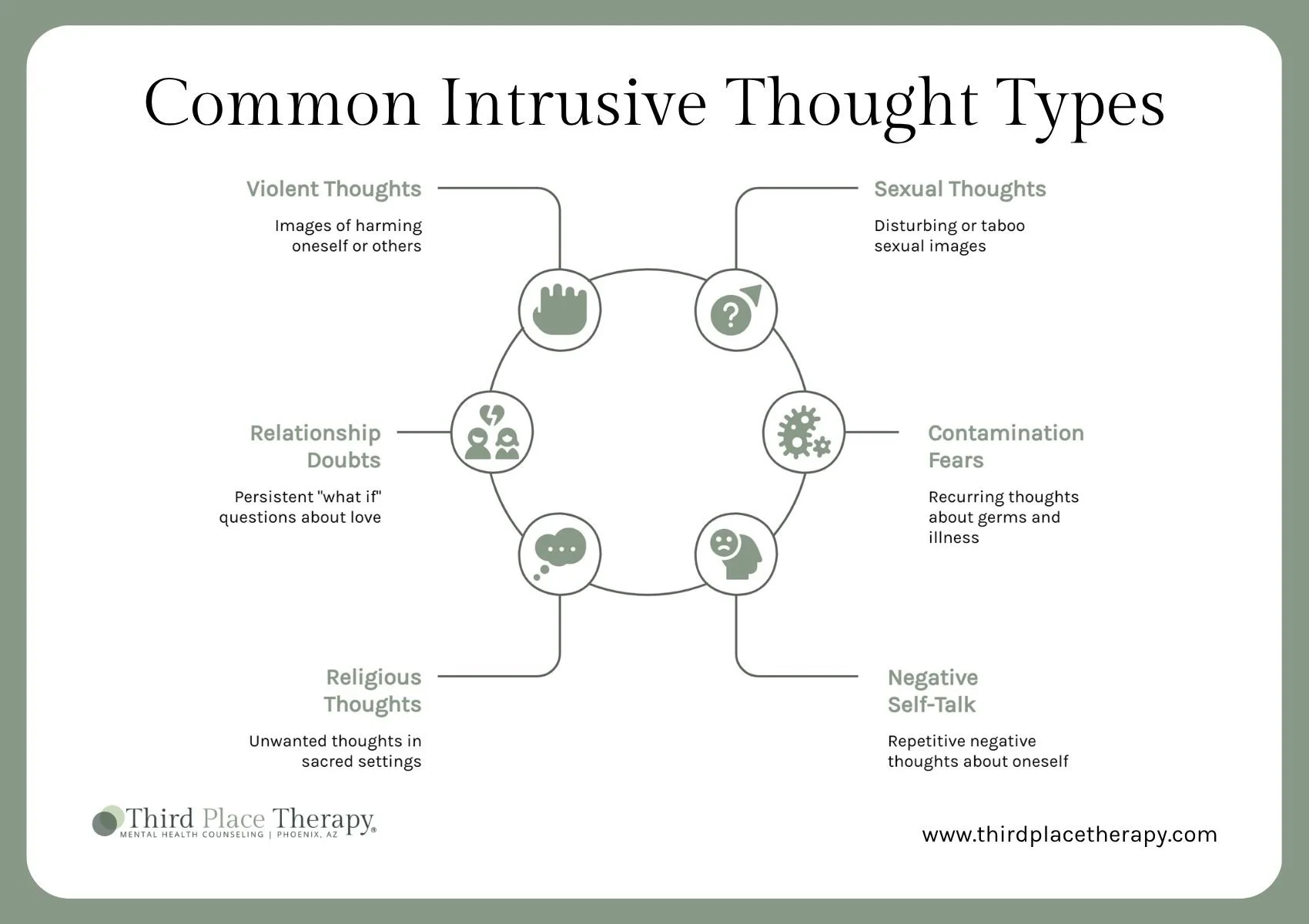
The most common types include:
Violent or harm-focused thoughts: Images of hurting yourself or someone you love, even when you have no desire or intention to do so.
Sexual intrusive thoughts: Disturbing or taboo sexual images that feel completely inconsistent with your identity or values.
Relationship doubts: Persistent "what if" questions about whether your partner is right for you, or whether you truly love someone.
Contamination or illness fears: Recurring thoughts about germs, disease, or being responsible for making someone sick.
Religious or blasphemous thoughts: Unwanted thoughts that arise in sacred settings or contradict deeply held spiritual beliefs.
Negative self-talk loops: Repetitive thoughts like "I'm such a loser" or "I ruin everything," which feel automatic and intrusive.
People with obsessive-compulsive disorder (OCD) often experience these thought categories most intensely, but they are not exclusive to OCD. Individuals with generalized anxiety disorder, post-traumatic stress disorder, postpartum depression, and ADHD also commonly report intrusive thoughts. New moms in particular may experience frightening thoughts about harm coming to their baby, which can be one of the most distressing experiences because it contradicts everything they feel for their child.
It is worth naming something directly: having a violent intrusive thought or a disturbing sexual thought does not make you a dangerous or bad person. These thoughts say nothing about your character. They are a reflection of how the anxious brain works, not a reflection of who you are.
Why Do People Have Intrusive Thoughts?
The brain is constantly generating thoughts, most of which fade quickly into the background. Intrusive thoughts are different in that they arrive with emotional weight and tend to stick around when you try to push them away. Understanding why this happens can take away some of their power.
Several factors are known to increase the frequency of intrusive thoughts. If you recognize yourself in patterns like constant over-preparation or an inability to switch off, it may also be worth reading about high-functioning anxiety, which often keeps intrusive thought cycles running quietly in the background.
Stress and anxiety: High-stress periods make the brain more hypervigilant. It scans constantly for threats, which increases the likelihood of catching any alarming or unexpected thought.
Sleep deprivation: A tired brain has fewer resources for regulating emotional reactivity, making thoughts feel more intrusive and harder to dismiss.
Mental health conditions: Obsessive-compulsive disorder, generalized anxiety disorder, post-traumatic stress disorder, PTSD, depression, and ADHD are all linked to higher rates of intrusive thoughts.
Hormonal shifts: Postpartum depression, menopause, and other hormonal changes can affect serotonin levels and increase vulnerability to distressing thoughts.
Trauma history: A traumatic event can leave the nervous system in a state of heightened alertness. Flashbacks and intrusive memories are a known symptom of PTSD and complex trauma responses.
From a neurological standpoint, intrusive thoughts may also involve the brain's default mode network, the system that activates during mind-wandering and self-referential thinking. When the brain's threat-detection system (the amygdala) is overactive, it may flag random thoughts as meaningful or dangerous, triggering a cycle of obsessive attention.
The key insight here is that intrusive thoughts usually become a bigger problem not because of the thought itself, but because of how the brain responds to it. Trying to suppress or argue with an intrusive thought tends to make it more persistent, a phenomenon psychologists call the "white bear effect." The thought intrudes more when you fight it, not less.
Are intrusive thoughts normal?
Yes. Research suggests that approximately 94% of people experience intrusive thoughts at some point. Having an occasional disturbing or unwanted thought does not mean something is wrong with you.
How Intrusive Thoughts Affect Daily Life
For most people, intrusive thoughts are a passing nuisance. They appear, they feel unpleasant, and they fade. But for others, intrusive thoughts can cause significant distress and begin to erode the quality of daily life in ways that are hard to articulate to someone who has not experienced it.
Some of the ways intrusive thoughts can interfere with daily functioning include:
Difficulty concentrating at work or in conversations because the thought keeps returning
Avoiding situations, people, or objects that might trigger the thought
Spending mental energy arguing with the thought, trying to prove it wrong or reassure yourself
Feeling ashamed or secretive, isolating yourself because you believe the thought says something terrible about you
Sleep disruption from thoughts that escalate at night when there are fewer distractions
Relationship strain from intrusive doubts, fear, or withdrawal
The cognitive distress that accompanies intrusive thoughts often includes patterns like catastrophizing ("this thought means I'm dangerous"), mind-reading ("everyone would be horrified if they knew"), and emotional reasoning ("I feel terrified by this thought, so it must be real"). These thought patterns are the fuel that keeps intrusive thoughts burning.
It is worth recognizing when intrusive thoughts have crossed from occasional and manageable to frequent and disruptive. There is no shame in reaching a point where the thoughts are getting in the way of your daily life. That is not a moral failure. That is information telling you it is time to get some support.
What Triggers Intrusive Thoughts?
Intrusive thoughts often feel completely random, which is part of what makes them so unsettling. But there are common patterns in what tends to trigger them. Identifying your personal triggers is one of the most useful early steps in learning to manage intrusive thoughts.
Common triggers include:
High-stakes moments: Holding a baby, standing near an edge, driving, or being in a situation where harm is theoretically possible
Emotional exhaustion: When you are depleted, the brain's ability to filter and dismiss random thoughts is reduced
Major life transitions: Becoming a parent, losing someone, starting a new job, or ending a relationship can activate the threat system and increase intrusive experiences
Relationship closeness: The people we love most are often the subjects of our most disturbing intrusive thoughts, precisely because losing them feels most unbearable
Quiet, unstructured time: Without an external focus, the mind turns inward, and intrusive thoughts tend to surface more in stillness
Substances: Alcohol, caffeine, and other stimulants can disrupt the brain's regulatory systems and increase intrusive thought frequency
Understanding your triggers does not mean avoiding them forever. In fact, chronic avoidance of triggers tends to maintain and strengthen the intrusive thought cycle. Behavioral approaches like cognitive behavioral therapy use graduated exposure to help individuals learn that they can tolerate the trigger without catastrophe. This is not about being tough. It is about teaching the nervous system that the trigger is not actually dangerous.
How to stop intrusive thoughts?
The counterintuitive answer is that trying to stop or suppress intrusive thoughts often makes them worse. More effective approaches include labeling the thought without analyzing it and working with a therapist if the thoughts are rooted in anxiety or trauma.
Managing Intrusive Thoughts: What Can Help
Learning to manage intrusive thoughts is a skill, and like any skill, it takes practice. The goal is not to eliminate every unwanted thought, because that is neither possible nor necessary. The goal is to change your relationship with the thought so it loses its grip on your attention and your day.
Evidence-based strategies that therapists commonly recommend include:
Label the thought, do not argue with it
When an intrusive thought arrives, try saying to yourself: "There is that intrusive thought again." Naming it reduces the emotional charge and interrupts the loop of trying to disprove or analyze it.
Allow the thought to pass rather than suppress it
Suppression increases persistence. Acceptance, acknowledging the thought without attaching meaning to it, allows it to move through more naturally.
Cognitive defusion (from ACT)
Create psychological distance by saying "I am having the thought that..." before the thought. This reminds the brain that you are not the thought.
Grounding techniques
When a thought is causing acute distress, use the 3-3-3 rule: name three things you see, three sounds you hear, and move three parts of your body. This pulls attention back into the present moment.
Cognitive behavioral therapy (CBT)
CBT is one of the most well-supported approaches for helping people learn to manage intrusive thoughts with cognitive restructuring and behavioral techniques.
Mindfulness practice
Regular mindfulness training builds the capacity to observe thoughts without automatically engaging with them, which is one of the most powerful tools for intrusive thought management.
Regular sleep and movement
Both directly affect the brain's capacity to regulate emotions and dismiss intrusive thoughts. These are not secondary recommendations; they are foundational.
These strategies are most effective when practiced consistently, not just in moments of crisis. For a broader toolkit, our guide oncoping skills for anxiety covers additional approaches that pair well with intrusive thought management. If you find yourself stuck in a pattern despite your best efforts, that is a signal that working with a therapist would make a meaningful difference
Are intrusive thoughts harmful?
Intrusive thoughts can feel scary or upsetting, but they are not usually harmful on their own. They are unwanted thoughts that can pop into your mind without warning, and having them does not mean you want to act on them or that they reflect who you are.
When Should You Seek Help for Intrusive Thoughts?
Not every intrusive thought requires professional support. Many people experience occasional, fleeting intrusive thoughts and manage them just fine without therapy. But there are clear signs that it is time to reach out for help, and recognizing them early makes a real difference in how quickly you can find relief.
Consider talking to a therapist if your intrusive thoughts:
Occur frequently and are difficult to dismiss
Cause significant anxiety, shame, or distress that lasts beyond the moment
Are leading you to avoid people, places, or activities
Have started to interfere with your work, relationships, or sleep
Feel connected to a traumatic event or ongoing PTSD symptoms
Are accompanied by compulsive behaviors you feel driven to perform
Involve thoughts about self-harm or harming others that feel more than fleeting
If your intrusive thoughts are distressing but not a crisis, know that they are highly treatable. Research on cognitive behavioral therapy and EMDR consistently shows significant improvement in people who seek support. You do not have to white-knuckle your way through this alone, and you deserve care that actually addresses what is happening beneath the surface.

Working with Intrusive Thoughts in Therapy
If your intrusive thoughts are causing real distress, you already know that willpower alone is not enough. Understanding the thoughts intellectually helps, but the kind of change that actually sticks usually happens in a therapeutic relationship where you feel genuinely safe and understood.
Intrusive thoughts often carry weight beyond the thought itself. For many people, they are connected to deeper experiences of anxiety, trauma, shame, or a nervous system that never quite got the message that it is safe to rest. Working through that layer is what makes lasting relief possible.
At Third Place Therapy, we use EMDR, Internal Family Systems (IFS), and trauma-informed CBT to help clients move through the intrusive thought cycle at its roots. The work is not about fixing what is wrong with you. It is about understanding what happened to you, and helping your mind find a new way to respond. That looks different for every person, and there is no prescription that applies to everyone.
If you are ready to explore what support might look like for you, reaching out for a consultation is a low-stakes first step. You are allowed to ask for help, and you do not have to have it all figured out before you do.
Ready to talk? Schedule a free consultation today.
