
Postpartum Depression in Men: What Dads and Partners Need to Know
You're exhausted in a way that sleep doesn't fix. You love this baby, but some days you feel nothing at all. You snap at your partner over something small, then feel awful about it an hour later. If any of that sounds familiar, we want you to know that postpartum depression in men and non-birthing partners is real, it has a name, and it's far more common than most people realize.
In this guide, we'll walk through:
Why postpartum depression in men looks different than the version most people picture
The hormonal changes happening in your body right now
Risk factors, including what happens when your partner is struggling too
How to help a partner with postpartum depression if that's what brought you here
Screening tools and real next steps
Let's start with the part most people never hear.
Yes, Dads and Partners Can Get Postpartum Depression Too
Postpartum depression isn't only a maternal experience. According to a JAMA meta-analysis of over 43,000 fathers, about 1 in 10 new fathers experience depression during the perinatal period, and that number climbs to roughly 25% among men whose partner is also experiencing postpartum depression.
That's not a small footnote. That's millions of dads and non-birthing parents quietly struggling while everyone around them asks how mom is doing.
This isn't the same as the baby blues, which tend to fade within a couple of weeks. Postpartum depression in partners can settle in and stay, sometimes for months, if it isn't named and addressed.

What About Depression Before the Baby Arrives? (Paternal Antenatal Depression)
Postpartum depression doesn't always start after birth. Some dads and partners notice symptoms during pregnancy itself, something researchers call paternal antenatal depression. It's easy to miss, since most of the attention during pregnancy is on the parent who's carrying the baby.
This stage matters more than people think. Symptoms that show up before birth are one of the strongest predictors of how severe postpartum depression becomes. Naming it early, even during pregnancy, can change the whole trajectory.
Why Postpartum Depression Looks Different in Dads
Here's something we wish more people knew going in. Male postpartum depression rarely looks like the crying, withdrawn sadness we associate with new moms. It often hides behind something else entirely.
Signs of Postpartum Depression in Partners
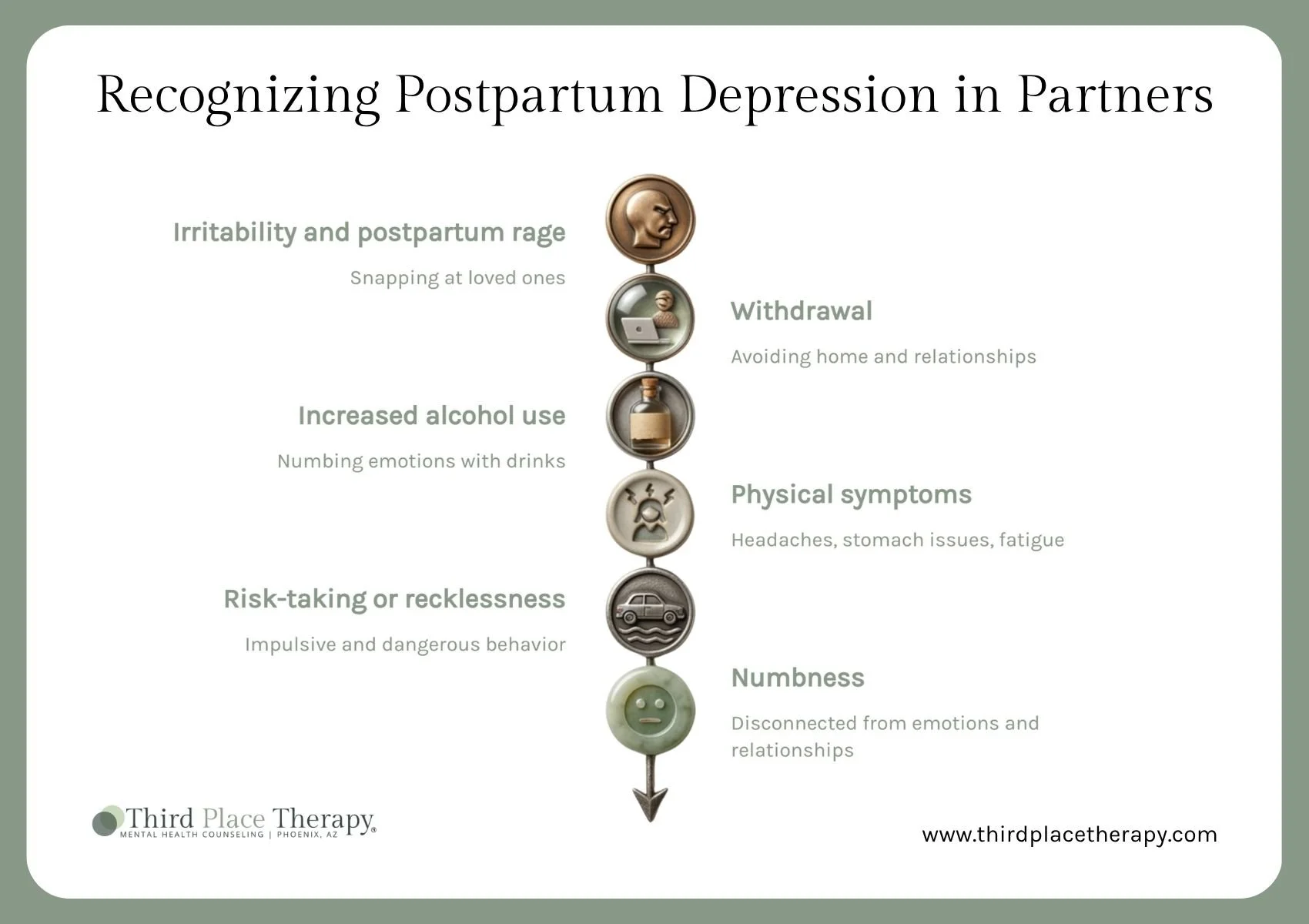
We tend to see these signs most often:
Irritability and postpartum rage. Snapping at your partner, older kids, or coworkers over things that normally wouldn't bother you
Withdrawal. Working longer hours or disappearing into hobbies, screens, or errands to avoid being home
Increased alcohol use. Reaching for a drink more often to numb out or unwind
Physical symptoms. Headaches, stomach issues, or fatigue that doesn't improve with rest
Risk-taking or recklessness. Driving faster, picking fights, or making impulsive decisions
Numbness. Feeling disconnected from the baby, your partner, or your own emotions
That word "rage" deserves its own moment. Postpartum rage in new dads and partners isn't a character flaw. It's often depression wearing a different mask, fueled by sleep deprivation, hormonal changes, and the pressure of holding it all together while feeling like you can't say a word about it.
How Male PPD Symptoms Differ From the Textbook Version
Most clinical descriptions of postpartum depression focus on internalizing symptoms: sadness, guilt, crying, feeling worthless. That's the textbook version, and it's largely built around research on mothers.
Male postpartum depression tends to externalize instead. Anger, irritability, escapism, and numbness show up more often than tears. Because it doesn't match what most people expect depression to look like, it gets missed, brushed off as stress, or mistaken for a bad attitude rather than a treatable condition.
Can a man get postpartum depression?
Yes. About 1 in 10 fathers experience postpartum depression, with rates rising to nearly 25% among men whose partner is also depressed. It's a recognized condition, not a personal failing.
The Hormonal Changes Behind Paternal Postpartum Depression
Your body goes through more of a shift than most people realize. This isn't weakness. It's chemistry.
Testosterone levels in new fathers drop significantly, with research from Northwestern University finding declines of 26 to 34% on average and up to 50% in dads who are the most hands-on with caregiving, per a longitudinal study published in PNAS. At the same time, cortisol tends to rise with sleep deprivation and stress, while prolactin and vasopressin shift to support bonding with your new baby.
These changes are part of how your body prepares you to parent. But when they combine with exhaustion, financial pressure, and a total identity shift, they can also open the door to depression and anxiety.
Risk Factors: What Makes Some Dads and Partners More Vulnerable
A few things tend to raise the risk of depression in fathers and non-birthing parents:
A personal history of depression or anxiety
Financial stress or job insecurity
Relationship conflict or feeling disconnected from your partner
Limited social support or few people to talk to honestly
A traumatic or difficult birth experience
Pressure to "hold it together" because that's what men are taught to do
How a Partner's PPD Raises Your Own Risk
This one matters most. When your partner has postpartum depression, your own risk of developing it increases by roughly 50%, according to a review on paternal postpartum depression's impact on the whole family. Depression in one parent doesn't stay contained. It ripples through the household, which is exactly why we treat this as a family issue rather than an individual one.
The same research shows paternal depression can affect infant bonding, maternal recovery, and even breastfeeding outcomes. Getting support isn't just for you. It changes things for your whole family.
What does postpartum in men look like?
It often looks like irritability, anger, or withdrawal rather than sadness. Common signs include postpartum rage, increased alcohol use, overworking to avoid being home, and physical symptoms like headaches or fatigue.
The Role of Masculinity Norms and Cultural Pressure
Many men grow up hearing some version of "man up." Push through it. Don't complain. Handle it. That script doesn't leave much room for admitting you're struggling, especially when you're supposed to be the steady one for a newborn.
That pressure is a big reason paternal depression is underreported. Men are less likely to bring up mood symptoms with a doctor, and more likely to describe what they're feeling as stress instead of depression.
It's worth reframing this: reaching out for support isn't a failure to provide for your family. It's one of the most protective things you can do for them.
How to Help a Partner With Postpartum Depression
If you're reading this because you're worried about your partner rather than yourself, here's where to start.
Say what you've noticed, gently. "I've noticed you seem more on edge lately, and I want to check in" lands better than "What's wrong with you?"
Skip the fix-it instinct. Avoid phrases like "just think positive" or "you'll be fine." They minimize something real.
Offer to help find a therapist together. Making the first call together can lower the barrier significantly
Take care of your own mental health too. You can't pour from an empty cup, and couples counseling can help both of you feel steadier
Relationship strain is common during this period for both partners. If conflict has been building, couples therapy can give you both a space to reconnect instead of drifting further apart.
Screening Tools and When to Reach Out
Most standard postpartum screenings were built for mothers, which means paternal depression often gets missed entirely. The Edinburgh Postnatal Depression Scale (EPDS) is still useful for dads, with a recommended cutoff score of 10 or higher. Researchers have also studied the Gotland Male Depression Scale, designed specifically to catch male-pattern symptoms like irritability and anger, per a study comparing both scales in new fathers.
If several of these signs sound familiar, or your partner has flagged concerns you hadn't named yourself, it's worth self-screening and bringing the results to a health care provider.
Postpartum Support International also runs a dedicated helpline and support groups for dads, and it's free and confidential.
And if you're in Arizona, our team offers postpartum depression therapy for dads, partners, and non-birthing parents, not just moms. Treatment options like therapy are highly effective, especially when tailored to how depression actually shows up in men, and online therapy makes it easier to fit into a schedule that's already stretched thin.
How long does postpartum depression last in men?
Symptoms often begin prenatally, peak around 3 to 6 months postpartum, and can persist up to 12 months without treatment. With therapy, many men start feeling better within weeks.
Treatment Options for Dads: Therapy, Medication, and Peer Support
Once you've named what's going on, there are real options. Not just "push through it."
Individual therapy. Trauma-informed approaches like EMDR address what's underneath the irritability or numbness, not just the symptoms on the surface. This tends to be the most effective starting point for male postpartum depression specifically.
Medication. For moderate to severe symptoms, a doctor or psychiatrist may recommend an antidepressant alongside therapy. That's not a sign therapy failed. Sometimes bodies need both.
Peer support groups. Talking to other dads who've been through it can cut through the isolation fast, and Postpartum Support International runs groups built just for fathers.
One more thing worth naming: online therapy has made all of this far more accessible. You don't need to carve out a lunch break and drive across town. A session can happen from your car, your office, or after the baby's finally asleep, which matters when your schedule barely has room to breathe.
Our team offers postpartum depression therapy for dads, partners, and non-birthing parents across Arizona, both in person in Phoenix and online statewide.
Reach Out. We're Here for You
At Third Place Therapy, we believe the whole family deserves support during the postpartum period, not just the parent who gave birth. We know how hard it is to say "I think I need help" when you've spent your whole life being told to push through.
Our mental health professionals use trauma-informed, evidence-based approaches like EMDR to help you process what's underneath the irritability, the numbness, or the rage, not just manage the symptoms on the surface. We work with dads, partners, and non-birthing parents across Arizona, in person in Phoenix or online anywhere in the state.
If any of what you read today felt familiar, schedule a free consultation, and let's figure out together what support could look like for your family.
What type of therapist is best for postpartum depression?
Look for a therapist with specific perinatal mental health training, ideally the PMH-C credential, and a trauma-informed, nonjudgmental approach. Many moms benefit from therapists who use EMDR or IFS alongside talk therapy, especially when birth trauma or identity shifts are part of the picture.
