
The cheerful holiday card is on the fridge. The empty chair is at the table. You might be wrapping gifts and smiling for the family photo while missing someone so much it aches. Both of those things are true, and one does not cancel out the other.
The songs promise "the most wonderful time of the year," but grief during the holidays rarely follows that script. If you feel sad, numb, angry, or all of it at once, nothing is wrong with you. We are the therapists at Third Place Therapy, a team led by Elaine Evans, LPC, EMDR Certified, and we offer grief counseling in Phoenix. Below are some strategies many people find helpful this time of year. Take what fits and leave the rest.
Why Holiday Grief Feels Heavier This Time of Year
The holiday season runs on rituals: the same recipes, the same songs, the same people in the same rooms. When someone you love is missing from those rituals, the gap can feel louder than it does the rest of the year. Shorter days, packed calendars, and pressure to feel cheerful can add to the weight.
Many people also notice an anniversary reaction. Your body and mind remember the season before you even look at the calendar. Grief can intensify in the days or weeks before a holiday, and some people find that the buildup is harder than the day itself.
When "Happy Holidays" Does Not Match How You Feel
People who care about you may tell you to look on the bright side or to cheer up for the kids. Grief is not a problem to solve, and you do not have to perform joy for anyone. You might try saying a few of these to yourself:
"It makes sense that this is hard."
"I am allowed to feel what I feel today."
"Missing them shows how much I love them."
Grief and Joy Can Exist Together
Laughing at a holiday gathering does not betray the person who died or is no longer in your life. Imagine a cousin telling a story that has the whole table laughing, and then, a minute later, you notice the dish your loved one always brought is not there. Grief and joy can share the same breath. Moments of joy do not erase your love or your loss.
Is it normal to feel more grief during the holidays, even years after a loss?
Yes. Holidays are full of rituals, music, food, and gatherings tied to the people we love, so grief can return or intensify this time of year, even many years later. This is a common experience. It does not mean you are going backward. It means the love is still there.
Understanding the Waves of Grief During the Holiday Season
Many people describe grief as coming in waves. A wave can rise without warning, peak, and then recede, sometimes in the middle of a store or a family dinner. You do not have to stop a wave. You can ride it.
When you feel one building, try pausing, taking a few slow breaths with longer exhales, or stepping outside for five minutes. Some people put a hand on their chest and name it: "This is a grief wave, and it will pass." A rough hour does not mean the whole day is ruined. Coping with grief often means shifting our response to one that welcomes the waves rather than avoids them.
Handling Sensory Triggers: Smells, Songs, Food, and Places
Smell, sound, and taste can bring a memory back before your mind catches up. One note of a song or the scent of a certain cookie can stop you in your tracks. That is not weakness. It is how memory works. Here are some common holiday triggers and one thing that may help with each.
| Trigger | What it can stir up | One thing that may help |
|---|---|---|
| A favorite song | A sudden wave of longing | Step away, or choose to listen on purpose when you have space |
| A family recipe or smell | Memories of cooking together | Make it with someone and share a story, or skip it this year |
| A familiar place | Feeling the absence sharply | Go with a trusted person and plan a time to leave |
| A family tradition | Pressure to keep everything the same | Decide ahead of time to keep, change, or skip it |
| Social media | Comparison and feeling left out | Mute accounts or take a break for a few days |
Using an Imagined Safe Place
An imagined safe place is a quick coping tool you can use anywhere, even in a crowded room. Soften your gaze or close your eyes. Picture a place where you feel calm, it can be a real place like a beach you visited or imagined like a castle in the clouds. Notice what you see, hear, and feel there. Stay for a few breaths, then come back to the room.
It is a grounding skill, not a cure. We often use it when preparing clients for EMDR, and if you are curious, you can read about what EMDR is and how it works.
A Cope-Ahead Plan for the Day Itself
A cope-ahead plan means making a few decisions before the day arrives, so you do not have to make them in the middle of a wave. One simple idea: choose a soothing drink ahead of time, like warm tea, cocoa, or a favorite sparkling drink, and keep it in your hands at the gathering. It gives you something comforting to hold, and it is a kind option if alcohol does not feel helpful that day.
A few other ideas for your plan:
Eat something before you go.
Bring your own transportation so you can leave when you need to.
Plan an exit line ahead of time.
Decide who you will text if a wave hits or you feel the urge to isolate.
Pick one small act of self-care for later that evening.
If you keep circling back to the same old wound, trauma-informed individual therapy can help you understand where a reaction is really coming from and build new ways to respond.
Book a free 15-minute consultationPlanning for Other People's Questions and Reactions
Someone will probably ask, "How are you doing?" Planning a few answers ahead of time can take the pressure off. You get to decide how much you share.
A short answer: "It is a hard season, but I am glad to be here."
A redirect: "Thank you for asking. How is your new job going?"
A boundary: "I would rather not talk about it today, but I appreciate you."
Declining an invitation: "I love you all, and I am going to sit this one out this year."
Telling family your plans: "I will come for dinner, and I will probably leave before dessert. I wanted you to know ahead of time."
Use these as often as you need.
Choosing a Trusted Person to Call or Text
Before the holiday, choose one trusted person. Tell them what you might need, whether that’s distraction, a listening ear, or a ride home. You can even agree on a signal, like a single emoji, that means "please check on me."
Grief can feel isolating, and it is tempting to pull away from everyone. Asking for help in advance means you do not have to find the words in a hard moment. It is also a reminder that you are not alone.
Is it okay to enjoy the holidays when I am grieving?
Yes. Grief and joy can exist together. Laughing, celebrating, or feeling glad does not mean you have forgotten someone you love. You do not have to perform happiness, and you do not have to avoid it either. Both feelings are allowed.
Coping With Grief During the Holidays: What to Expect Across the Years
There is no timeline for grief and no "right" year to feel better. Coping with loss can look different every season. David Kessler, a grief expert, suggests that when we ask "How long is too long to grieve?" a better question is "How long is too long for someone to matter to you?" Your grief is a sign that someone matter mattered to you, and there's no timeline on that.
The First Holiday Season After a Loss
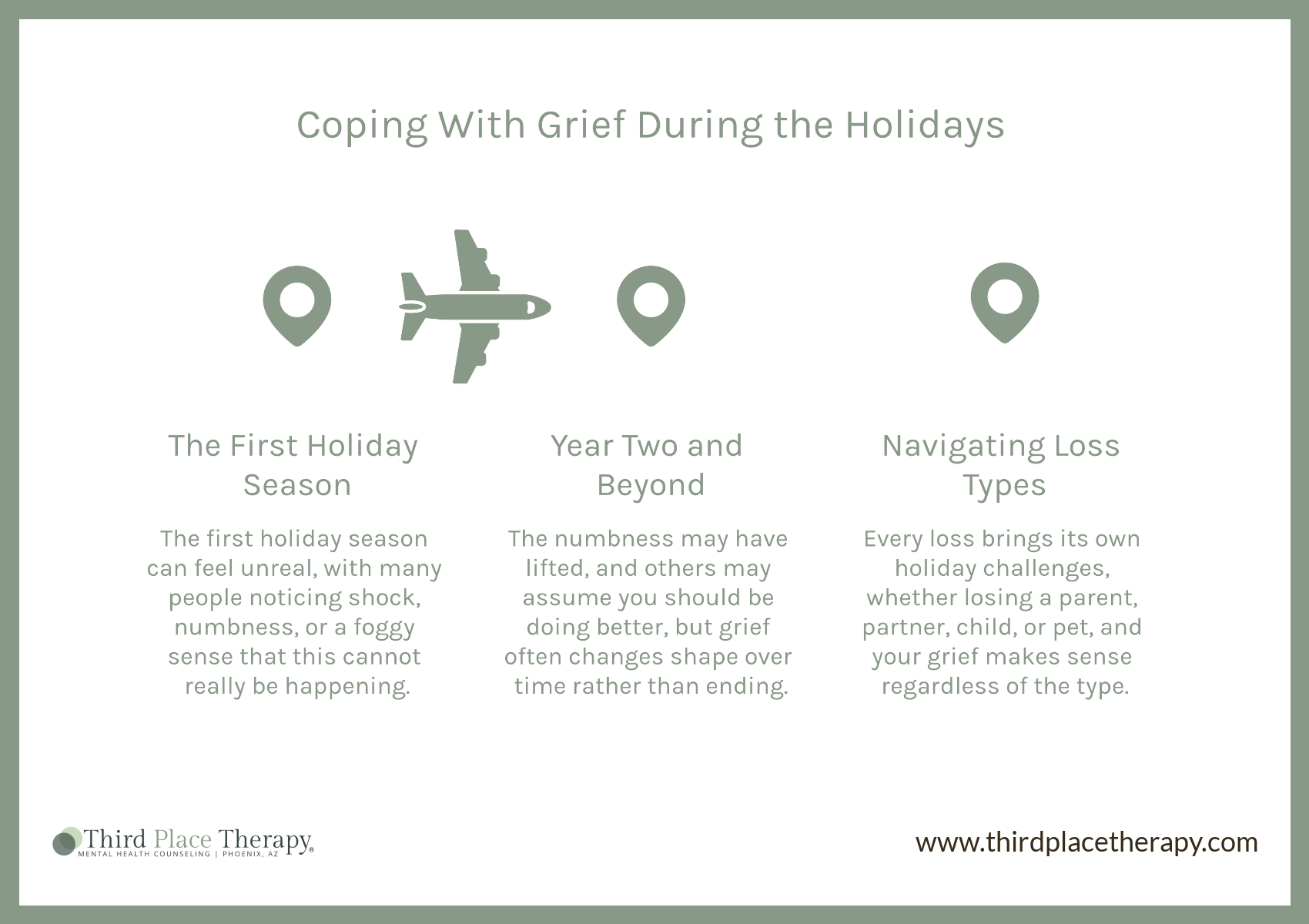
The first holiday season can feel unreal. Many people notice shock, numbness, or a foggy sense that this cannot really be happening. You are allowed to keep plans small and flexible, and it is okay to change them at the last minute.
Year Two and Beyond
Some people find the second year harder than the first. The numbness may have lifted, and others may assume you should be "doing better" by now. Grief often changes shape over time rather than ending. You might honor old traditions as they were, or start new ones that make room for your loss.
Differences by Loss Type
Every loss brings its own holiday challenges. Losing a parent can mean losing the person who held the traditions together. Losing a partner can make couple-centered events and gift shopping feel painful. Being estranged from a parent or adult kid can also make holiday gatherings feel especially lonely. After the loss of a child, including pregnancy or infant loss, child-focused celebrations can be especially tender, and others may not know how to acknowledge your grief.
Losing a pet can change the daily rhythm and feel of home, and that grief deserves space too. Whatever your loss, your grief makes sense, even if it does not look like anyone else's.
Grieving During Christmas and Other Family-Centered Holidays
Grieving during Christmas, Hanukkah, Kwanzaa, Diwali, or any family-centered holiday can carry extra weight. The focus on togetherness, gift-giving, and gatherings can leave a clear gap where someone you love used to be.
Some ways people choose to honor a loved one:
Light a candle at dinner.
Share a favorite story about them.
Cook their signature dish.
Hang an ornament or set out a photo.
For each tradition, you can ask: do I want to keep it, change it, or skip it this year? There is no wrong answer. You can opt out of anything that feels like too much, and try again another year if you want to.
Supporting Grieving Children During the Holidays
Children grieve too, though it often looks different from adult grief. Many children grieve in short bursts. A child might ask a very direct question, play happily for an hour, and then get upset over something small. That back-and-forth is common and does not mean they are unaffected.
Clear, simple language about the death usually helps more than vague phrases like "went to sleep," which can confuse young children. Keeping routines where you can, such as meals and bedtimes, can offer a sense of safety. Guidance from the AAP on HealthyChildren.org suggests using words that match a child's age and keeping routines in place. It also notes that children sometimes hide their own grief because they worry that sharing it will make the grown-ups around them feel worse. The AAP clinical report on grieving children includes advice on preparing for grief triggers and anniversary reactions, which the holidays often bring.
A few ways to include children without pressure:
Invite them to draw a picture or write a note for the person who died.
Let them pick a song or food to share in that person's memory.
Answer questions simply, even when they ask the same thing more than once.
Let them choose whether to take part.
If you have questions about how your child is coping, your pediatrician or a child therapist is a good person to ask.
How do I support a grieving friend or family member during the holidays?
Say the name of the person who died, since many grieving people want to hear it. Offer specific help, like "Can I drop off dinner on Thursday?" instead of "Let me know if you need anything." Do not push them to attend events or to feel a certain way. Check in after the holiday too, when support often fades.
Holiday Grief Support: When Extra Help Can Make a Difference
You do not need to be in crisis to talk with someone. Many people reach out for professional support simply because grief feels heavy and they would like a steady place to set it down. Others find comfort in a grief support group, where people understand without needing an explanation.
Therapy and EMDR for Traumatic Loss
When a death was sudden, violent, or traumatic, memories can feel stuck or replay on a loop. EMDR (eye movement desensitization and reprocessing) is a therapy that uses side-to-side eye movements or taps to help the brain process painful memories so they may feel less raw. The American Psychological Association describes it as briefly focusing on a memory while doing these left-right movements, which can make the memory feel less vivid and intense. Many people find EMDR therapy helpful after a traumatic loss. Experiences vary, and it is one option among several.
Scheduling a Session Before or After the Holiday
Some people book a therapy session before a holiday to build a cope-ahead plan. Others prefer a therapy session after, as a place to process what came up. A session before might include practicing scripts, sorting out which traditions to keep, or rehearsing a grounding skill. A session after can be a space to talk through a moment that caught you off guard, or a moment of joy that surprised you. At Third Place Therapy, we believe you deserve that support and recommend both.
You set the pace, and there is no wrong time to start.
Signs It May Be Time to Reach Out
Grief and depression can share features, like sadness and trouble sleeping. Grief often comes in waves tied to memories of the person, while depression can feel more constant. A professional can help you make sense of what you are experiencing. You might consider reaching out if you notice:
Grief that feels unmanageable most days
Trouble getting through work, caregiving, or daily tasks
Thoughts of not wanting to be here
Relying on alcohol or other substances to cope
If you are having thoughts of suicide or self-harm, support is available any time. You can call or text 988 or chat at 988lifeline.org from anywhere in the United States to reach a trained crisis counselor, 24 hours a day. Therapy is not a crisis service, so 988 is the place to turn in those moments.
Reach Out to Third Place Therapy for Grief Support in Phoenix
If this season feels like too much to carry by yourself, you do not have to. At Third Place Therapy, we sit with people who are missing someone, whether the loss happened last month or a decade ago, and we never ask you to hurry. Many of the people we see are parents, partners, and caregivers who keep showing up for everyone else while privately hurting. We also support parents and adult kids navigating the ambiguous grief of estrangement or strained family dynamics. When a loss feels traumatic, we can include EMDR, and you set the pace. Our grief counseling services in Phoenix are available in person and online across Arizona.
You don't need the right words or a plan for what to say. A first conversation can be as simple as telling us what this season has been like. You can connect with our team through our contact page, call (480) 630-9018, or email elaine@thirdplacetherapy.com. We’ll take it from there. We would be glad to hear from you.
