
Myths About Emotions That Can Keep You Stuck
Many people have value associations with certain emotions. In our minds, we may have a subconscious list of “good” and “bad” emotions. Often, these lists are developed through what we have observed or been directly taught in early formative years.
For example, some people feel they should not feel emotions of jealousy or hate, and if they do feel jealousy or hate, they begin to feel guilty or ashamed for experiencing those emotions.
From a therapy-informed perspective, emotions are not flaws or weaknesses. They’re signals. They’re part of the nervous system’s way of giving us information about safety, connection, loss, boundaries, and needs.
In this article, we’re unpacking some of the most common myths about emotions, including:
The myth that there’s a “right” way to feel
Why strong emotions don’t mean you’re out of control
The idea that some emotions are “bad”
The belief that once you feel something, you're stuck with it
The assumption that other people can make you feel a certain way
Curious to see which ones you’ve heard or maybe even believed? Keep reading to find out what’s myth, what’s truth, and how understanding the difference can change the way you relate to your emotions.
Emotion Myths Debunked: What Are Emotions?
Let’s clear the air about emotions. What are they? What’s true about emotions, and what are the things we’ve been taught that might not actually be true? Are certain emotions "bad"?
Many people assume they already know what emotions are, but they’re often working from half-learned ideas, childhood messages, or cultural myths. Especially for high-achieving adults, emotions can feel confusing, inconvenient, or hard to trust. So, slowing down and asking what emotions actually are can be surprisingly grounding and clarifying.
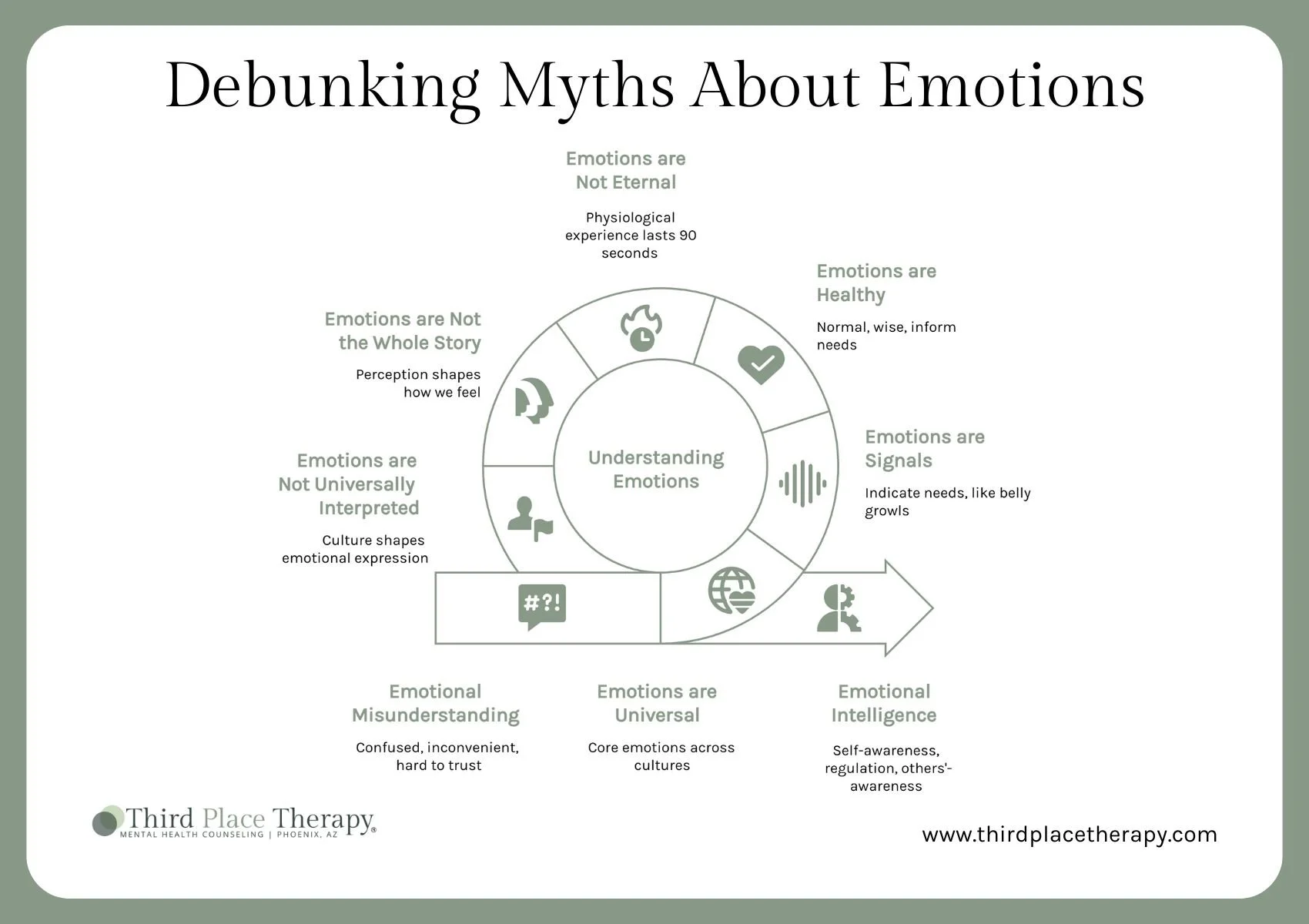
1. Emotions are universal
Emotions can feel so subjective, so it’s hard to imagine emotions as a science that can be studied, but there’s actually a lot of research on emotions - and still so much research to be done.
Psychological research demonstrates that human emotions can be studied by measuring facial movements. Studies with individuals of all age groups, genders, and cultures demonstrate that emotions are a universal human experience. Researchers categorize emotions into a list of “core emotions.”
Dr. Paul Ekman is one such researcher whose recent studies suggest there are seven basic emotions, which include:
Anger
Fear
Disgust
Sadness
Surprise
Joy
Contempt
Can emotions be controlled or regulated?
Emotions themselves arise naturally, but emotion regulation is about how we respond once a feeling shows up. With practice, we can regulate our reactions consciously without suppressing the emotional experience.
2. Emotions are a signal
Think about the last time you were walking through the woods and saw a bear. (Okay, hopefully you haven’t experienced this, but imagine you have.)
Probably pretty immediately, you felt a physiological (bodily) response that you might know as fear. This demonstrates your body’s natural ability to respond to a situation with an emotion. The physiological response of your heart racing tells you there is a threat to your safety. This is important information to be aware of and actually may keep you alive in that moment.
While not as dire, recall a time when you tasted a bite of something rotten. Again, I hope you can’t relate, but imagine you could. Immediately, you’d probably feel a bodily sensation that you might call disgust. Feeling that emotion is adaptive and helpful - it may prompt you to not finish the meal and prevent you from having to spend the rest of the day in the bathroom.
Emotions tell us something’s going on in our environment.
In the same way that your belly growls to convey your need for fuel, your emotions act as a signal of information about something you need.
Here are some examples of emotions and what they might convey about what we need:
EMOTION —————————- NEED
Anger Justice, protection
Sadness Comfort, connection
Guilt Forgiveness, amends
Shame Connection, belonging
Fear Security, safety, reassurance
It’s as if we have multiple centers of intelligence - our bodies, our minds, and our emotions. We’re missing out if we’re tuning out a center of our intelligence.
How long do emotions actually last?
The physiological duration of a particular emotion is fairly brief - 90 seconds. What extends the experience is how our thoughts engage with it on a conscious level.
3. Emotions are healthy
For the simple fact that all humans have emotions, let me assure you - emotions are healthy. It’s good for you to feel them. It’s important for you to feel them.
Sure, some emotions are unpleasant and even painful. But there’s something incredibly wise about the way our bodies are able to pick up on what we’re experiencing, create a physiological response, and a mental interpretation that then helps us make sense of the world and our place in it.
Being emotionally attuned to yourself helps you navigate the world by informing you of your needs. Caring for your own needs allows you to be able to attune and attend to the needs of others - this is developed through the skill of emotional intelligence.
There are four components to emotional intelligence:
Self-awareness
Self-regulation
Others’-awareness
Relational regulation
Emotional intelligence is a significant area of focus in the realm of personal and professional development. Studies have found that EQ (emotional intelligence) actually gets people farther in their professional career than IQ. For example, The Marshmallow Experiment from Stanford found that children who were able to demonstrate delayed gratification (a self-regulation, emotional intelligence skill) made greater cognitive advancements when compared with peers who didn’t demonstrate delayed gratification.
While emotions can at times be inconvenient, uncomfortable, and even unwanted, they’re a healthy, normal part of life. The better we are at noticing and accepting our emotions, the easier it is to understand the message the emotion is conveying to then make a decision about how best to respond.
Other Common Myths About Emotions: What Emotions Are Not?
Once we have a basic understanding of what emotions are, the next helpful step is to clear away some of the misconceptions that tend to cause us trouble. Many of us aren’t struggling because of our emotions themselves, but because of the myths we learned about them along the way.
1. Emotions are not universally interpreted and valued the same
Based on culture, two individuals will interpret emotions and value their emotions in different ways.
Shame, for example, is experienced in light of cultural values. A culture that is collectivist in nature will experience shame in a particular way that differs from those in an individualistic culture.
Our life experience (particularly our upbringing) shapes the way we perceive emotion. In some family systems, emotions are perceived as weakness. Therefore, the value given to emotional expression is different from a family system in which expressing emotion is both safe and celebrated.
Culture and values will shape what is praised and desirable. As such, how emotion is displayed and interacted with will depend on values.
So while emotion is a universal experience (no human lacks emotion), the interpretation and expression of said emotions will likely vary based upon individual and cultural factors. This is an important reality because if we’ve grown up judging certain emotions as inappropriate, we can learn to interpret and value the emotion in a new way so that we can process it differently.
2. Emotions are not the whole story
Have you ever heard it said, “Feelings are not facts”? This is partly true. Your feelings are valid, true, and accurate according to your perception. However, our perception can be limited and sometimes doesn’t convey the whole story.
Let me explain further: emotions are one “Center of Intelligence,” if you will, amongst many “Centers of Intelligence” that are part of being human. Our bodies are another Center of Intelligence. Our minds are another Center of Intelligence. When we can see our emotions as a piece of information that contributes to a story of the whole picture, we can relate differently to emotion.
Everyone has a perception of the world that is unique to their experience, their present awareness, and their future hopes. As we’re going through life, our brain makes sense of the world through stories. The stories we make up shape our perception. Therefore, when we experience an emotion, our brain makes sense of that information by making an interpretation that fits with the narrative of our life.
Because we’re all unique, there are over 7 billion narratives and perspectives being experienced at once. Our perspective is just one of them. Perception will shape how we feel, and how we feel will shape our perception.
Imagine, for example, that you were in conflict with a colleague. You work to resolve the issue, and it concludes with an email stating nothing other than “Thanks.” Some will interpret this as the situation being resolved because they perceive their colleague as having positive intent, and a message of “Thanks” fits with appropriate etiquette in their perception. This person will likely feel content and at ease. On the other hand, another individual may perceive “Thanks” as passive-aggressive, according to their perception of the colleague’s intentions and beliefs about etiquette. This individual will likely feel unsettled or on edge as a result of receiving that message.
Perception shapes emotion.
If you’re struggling with difficult emotions in a relationship, consider checking in on what story you’re believing about the situation. If it’s an emotionally safe relationship, consider checking out your perception with the other person to determine if your interpretation is accurate.

3. Emotions are not eternal
Did you know that it’s actually impossible for a feeling to last forever? This will either be really great news or really sad news. When we have a positive emotion, we want to hold onto it and believe that it will last forever. When we experience an unpleasant emotion, we can hardly wait for it to pass.
Fortunately or unfortunately, emotional states are limited. Neuroscience has actually demonstrated that the physiological (bodily) experience of emotion only lasts 90 seconds (see research by Jill Bolte-Taylor).
This may sound totally untrue to you as you think about recent emotions that have stuck around for longer than an hour, or days even. What’s happening here is that your body is having the physical experience of an emotion, and then your mind is making an interpretation of meaning from that emotion, weaving it into the story you tell about yourself and the world, which may then be spurring on additional emotions that you feel “stuck” on.
The thing that is lasting is actually the narrative you’re living in that is interacting with your emotions.
Do different emotions serve different purposes?
Yes. Different emotions communicate different information. While they may feel uncomfortable, each emotional experience can support awareness, connection, and decision-making.
How Do We Handle Our Emotional Responses in Life
When we can practice a mindful awareness of emotion by getting some distance from the emotion, we can observe the physiological impact of the emotion without judging it or attaching meaning to it. In this process, we can mindfully observe our mind’s urge to attach certain meanings to the feeling. Then we can explore the meanings with curiosity and find the root.
Here’s an example: Let’s say you’re an entrepreneur and your business inquiries are trending down. You begin to feel your body slow down, an inertia, your face begins to droop, and you mindfully identify this as the emotion of disappointment. You take a deep breath and let the physiological response move through your body.
If your mind begins to jump toward judgment (I shouldn’t be feeling this way) or attaching meaning (I’m a failure), then you’re likely going to continue to experience emotions that make you feel as if you’re “stuck” on an emotion, but in actuality, it is your mind trying to make meaning of the emotion that is fueling subsequent emotions.
We can begin to shift our experience of emotion by practicing mindful, non-judgmental, compassionate curiosity rather than criticism, fear, or judgment.
Therapy can be a helpful next step in learning how to address emotions differently. Often, this process starts with relating to emotions with compassion and then becoming curious about the narratives we make up about ourselves and the world. We often inherited these narratives from early life experiences that first shaped our perception of ourselves and our place in the world.
Let’s Slow Down and Get Curious About Your Emotions
As therapists, we see how the biggest myths about emotions can distort emotional awareness and overwhelm even stable, high-achieving people. These common misconceptions about emotions suggest feelings are good or bad, rational or impulsive, meant to be controlled, ignored, or avoided.
In psychology and mental health work, we refute these myths about emotions. Emotions may influence how we react, behave, or manage certain situations, but they also motivate us, protect our well-being, and help us tolerate emotional pain.
Different people experience a wide range of emotions shaped by past experiences, facial expressions, and emotional intensity. Building emotional awareness rather than avoiding emotional reactions supports regulation, reduces anxiety, and helps manage your emotions consciously, even when feeling angry, hopeless, or uncertain.
Reach out to learn more about your own emotions.
