
Many adults arrive in therapy saying some version of this: “Nothing is technically wrong, but something doesn’t feel settled.”
You might be capable, successful, and thoughtful, yet relationships bring up anxiety that feels bigger than the situation in front of you. Time apart feels heavier than it should. Separation feels personal. And the fear of being left can quietly shape how you show up in love.
In this article, we’ll explore:
What separation anxiety in adults really looks like
Common symptoms of separation anxiety that often go unnoticed
How childhood attachment and trauma play a role
When anxiety may meet criteria for a diagnosable disorder
Ways of coping with separation anxiety and getting support
If any of this resonates, you’re not broken. You’re responding to something learned. And with the right support, healing is possible.

What Is Separation Anxiety in Adults?
The term “separation anxiety” is often associated with childhood. But adults can experience separation anxiety too, and they do, more often than many people realize.
Separation anxiety in adults refers to excessive fear or anxiety related to separation from an attachment figure. That figure might be a romantic partner, child, close friend, or even a therapist. The anxiety is not about dependency. It is about safety.
Separation anxiety in adults is now formally recognized in the Diagnostic and Statistical Manual of Mental Disorders (DSM-5-TR), published by the American Psychiatric Association. This was a significant shift. For years, adult separation anxiety was considered a neglected clinical syndrome.
Research suggests that approximately 6.6% of adults in the U.S. experience separation anxiety disorder at some point in their lives, and over 75% report onset in adulthood, not childhood.
Separation anxiety may show up alongside other anxiety disorders, such as:
Generalized anxiety disorder
Panic disorder or agoraphobia
Obsessive-compulsive disorder
For high-achieving adults, this anxiety often hides behind competence. You may look calm, but your nervous system is working overtime when connection feels uncertain.
How do you cope with separation anxiety?
Coping with separation anxiety starts by understanding that this type of anxiety is a nervous system response, not a weakness. Grounding practices, naming your feelings, and learning to calm panic attacks can help you manage symptoms day to day.
Symptoms of Adult Separation Anxiety Disorder That Often Go Unnoticed
Many adults with separation anxiety disorder grow up believing they are just “too sensitive” or that they overthink relationships. On the surface, it can look like worry, caring deeply, or wanting reassurance. Underneath, it’s anxiety tied specifically to separation from an attachment figure.
What makes adult separation anxiety tricky is how quietly it operates. It doesn’t always show up as panic. More often, it shows up as tension, preoccupation, and a constant sense that something could go wrong when distance is involved.
Common symptoms of separation anxiety disorder in adults include:
Recurrent, intense distress when anticipating or experiencing separation from a partner, child, parent, or other attachment figure
Persistent worry about losing an attachment figure or about them being harmed by illness, accidents, disasters, or death
Fear that something bad will happen to you that would permanently separate you from a loved one
Strong reluctance to travel, leave home, go to work, or be away because of separation-related anxiety
Difficulty being alone, even when independence is something you value
Trouble sleeping away from home or without being close to an attachment figure
Nightmares with themes of loss or separation
Physical symptoms such as headaches, stomachaches, nausea, chest tightness, or fatigue when separation occurs or is anticipated
For adults, at least three of these symptoms must be present for about six months to meet diagnostic criteria. This duration matters because adult separation anxiety often becomes part of how someone organizes their life rather than a passing phase.
Adults with separation anxiety disorder often struggle during breakups, dating, or moments of emotional distance. The anxiety is not dramatic. It’s quiet, chronic, and draining.
Importantly, these symptoms are not a sign of immaturity. They are a nervous system response rooted in fear and anxiety, not logic. Without treatment, adults may shape their lives around avoiding separation, often without realizing it.
Is separation anxiety normal in adults?
Yes. While separation anxiety is often associated with separation anxiety disorder in children, adults can experience it too. Anxiety is a regular part of life, but when fear around separation from loved ones becomes persistent or intense, it may be diagnosed as separation anxiety disorder in adults.
Causes of Separation Anxiety in Adults: Why This Fear Feels So Deep
To understand separation anxiety in adults, we need to look beyond surface behavior and into developmental history.
Separation anxiety disorder may develop from:
A history of childhood separation anxiety
Emotional inconsistency from caregivers
Loss, illness, or sudden separation early in life
Trauma where safety depended on proximity to an attachment figure
Children with separation anxiety disorder often grow up learning that closeness equals survival. Even if their adult life looks stable, their nervous system may still react as if separation is dangerous.
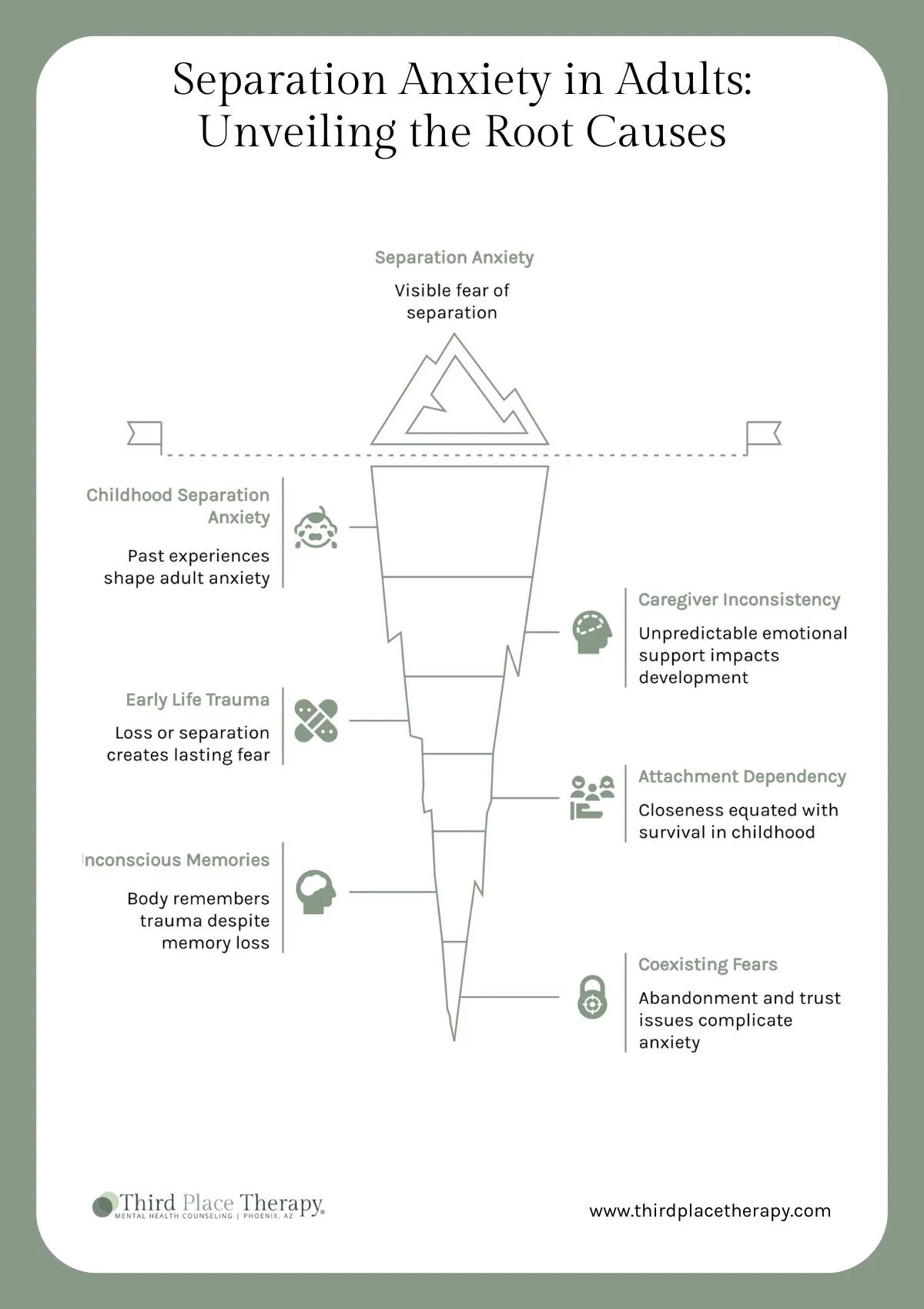
Research shows that anxiety is a normal developmental experience, but when early experiences overwhelm a child’s capacity to cope, anxiety can become embedded. Adults may not consciously remember early experiences. Yet their bodies do.
Separation anxiety often coexists with:
Fear of abandonment
Hypervigilance in relationships
Difficulty trusting emotional continuity
This is not about weakness. It is about adaptation. At one point, anxiety helped you stay connected. Now, it may be limiting your sense of freedom and security.
Coping With Separation Anxiety Without Shaming Yourself
When you’re an adult with responsibilities, goals, and people who rely on you, it can feel especially frustrating to experience separation anxiety. You might think, “I should be over this.” That shame often makes the anxiety worse, not better.
Instead, coping starts with a different stance: curiosity instead of criticism.
Gentle, grounded ways to respond when anxiety shows up:
Name what you feel. Simply saying, “I notice anxiety and fear of separation right now,” can reduce emotional intensity. Studies show that affect labeling (putting feelings into words) decreases amygdala activation and helps with emotional regulation.
Validate the part of you that’s scared. Internally saying, “Of course you’re anxious; separation used to feel dangerous,” builds internal safety instead of piling on self-judgment.
Limit reassurance loops. It’s okay to seek comfort, but try pairing external reassurance with inner reassurance: “They said they’re okay, and I’m here for myself too.”
Small shifts that support emotional regulation:
Mindfulness without self-attack. Even brief daily mindfulness can reduce anxiety symptoms and improve emotional regulation.
Create safety cues during separation. This might be a shared playlist, a saved voice note, a text you can reread, or a grounding object that reminds you of a secure connection.
Support your body. Gentle movement, paced breathing, and regular sleep help calm the nervous system; somatic-focused approaches are increasingly supported in anxiety treatment research.
Use compassionate self-talk, not control language. Instead of “I need to stop feeling this way,” try “This is a learned response, and I’m practicing new ways to cope.”
Coping with separation anxiety is less about forcing yourself to be “strong” and more about teaching your body that you are safe, loved, and not alone, even when someone you care about isn’t physically there.
How do people act when they have separation anxiety?
Adults with separation anxiety often experience intense worry about being away, distress during separation, reassurance-seeking, or panic attacks. Symptoms may also include difficulty sleeping or concentrating when apart from an attachment figure.
Support for the Parts of You That Are Tired of Holding It All Together
At Third Place Therapy, we work with adults whose lives appear solid yet feel quietly unsettled inside. Our approach to anxiety therapy is warm, depth-oriented, and grounded in attachment. We use EMDR, Internal Family Systems, and mindfulness to gently address anxiety at its roots, not just manage symptoms.
Working with us feels collaborative, steady, and non-judgmental. We move at your pace, prioritizing emotional safety while helping you build insight and lasting change, especially in relationships that matter most.
If something in you is curious about support, you are welcome to reach out. There’s no pressure. Help is here when you are ready.
