
You smiled in the hospital photos. You also feel your chest tighten when you drive past that building. Birth trauma is the distress that can stay with you after a birth that left you frightened, helpless or haunted.
Birth trauma therapy can help that memory feel less charged and help your body feel safe again. At Third Place Therapy, we offer EMDR, somatic therapy, and talk therapy. You don't need a diagnosis or a "bad enough" story to ask for support.
You can feel totally grateful to have your baby but also feel super upset about the delivery experience. Both of those things can be true at once, and neither cancels out the other. If you've been wondering whether what happened to you counts, our perinatal mental health support is a place to start.
Did My Birth Count as Trauma? Understanding Birth Trauma and PTSD
Birth trauma depends on how the birth felt to you, not on how it looked on a medical chart. A birth can be "healthy" on paper and still feel terrifying. As a 2022 cohort study put it, "childbirth with no medical complications, whether obstetric or neonatal, can nevertheless also be experienced as traumatic."
Common reactions include replaying the birth, avoiding reminders of it, feeling on edge, or feeling numb. You aren't alone in this. A meta-analysis of 154 studies found "pooled prevalence rates of 4.7% for PTSD and 12.3% for PTSS in mothers." PTSS means significant post-traumatic stress symptoms.
Birth Trauma vs. Postpartum PTSD
Birth trauma is the experience and the effects it leaves behind. Postpartum PTSD (post-traumatic stress disorder) is a pattern a professional can diagnose when symptoms persist over time. You don't have to meet those criteria to deserve help. Many people come to therapy with just a few symptoms and a sense that something isn't settled. Many parents with an unsettling birth experience feel that their negative birth experience inhibits their ability to enjoy and bond with their baby, and for that reason, decide to get support.
Obstetric Trauma: When Medical Care Itself Feels Frightening
Obstetric or medical trauma is distress tied to the care you received during pregnancy, birth or afterward. You may have felt unheard. A procedure may have happened before you understood it, or an emergency may have filled the room with people and urgency. Feeling scared during medical care doesn't mean you overreacted, and it doesn't mean anyone has to be blamed. What you felt is real. Medical trauma can impact our sense of agency and trust in our ability to be heard and supported.
What questions should I ask during a birth debrief?
Ask what you remember most, when you felt most scared, what you wish had been different, and what you still have questions about. You can also ask your care team about your medical records. A therapist can help you prepare for a hospital debrief and process what you learn there.
What Makes a Traumatic Birth Experience?
An emergency or unplanned cesarean
Feeling a loss of control during labor and delivery
Your baby going to the NICU
A hemorrhage or other sudden complication
Feeling dismissed when you said something was wrong
A difficult or traumatic pregnancy before the birth
Infant loss or pregnancy loss
Earlier trauma that the birth brought back up
Two people can go through the same birth and react very differently. Neither reaction is wrong.
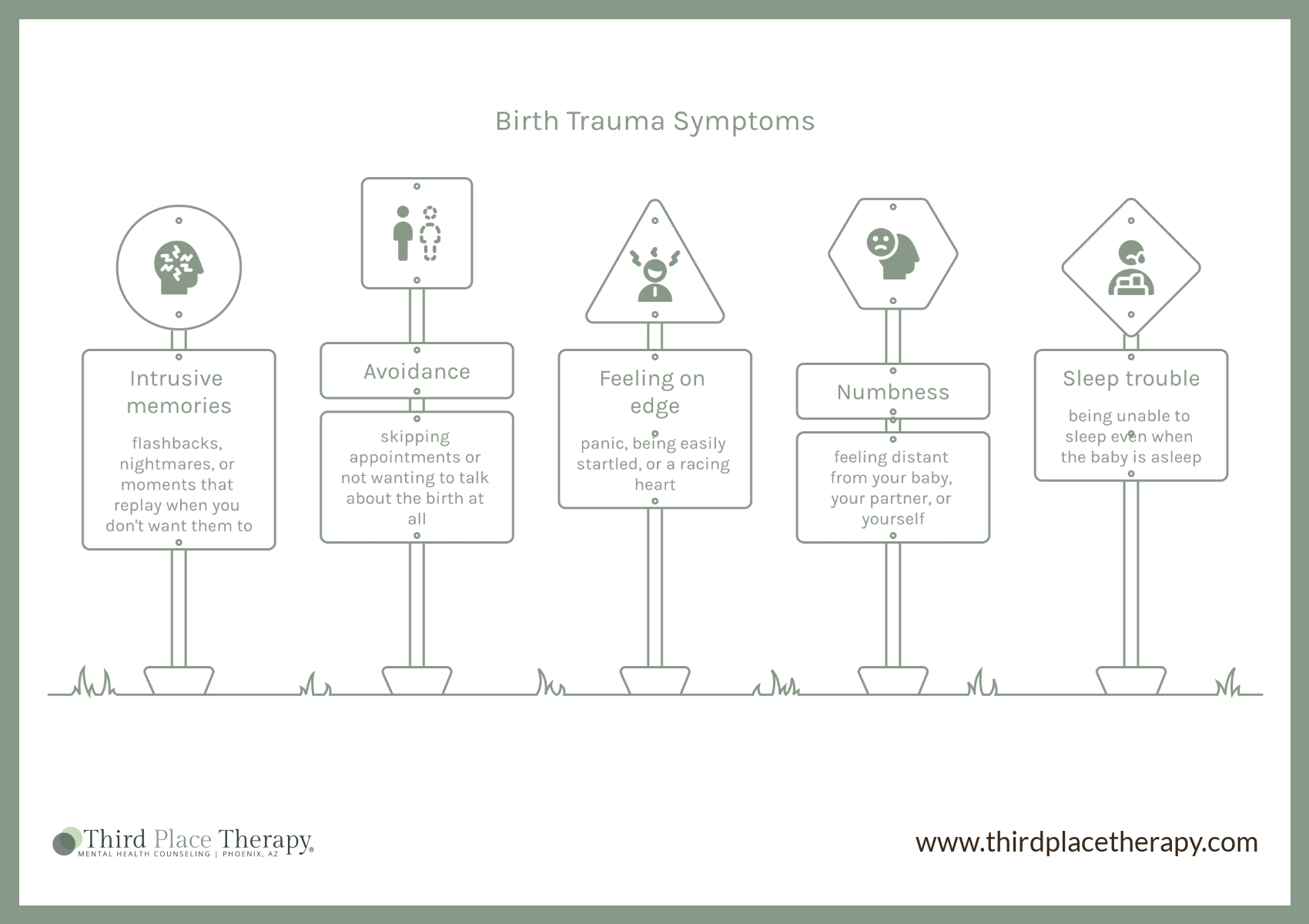
Birth Trauma Symptoms: What You Might Notice
Intrusive memories: flashbacks, nightmares, or moments that replay when you don't want them to
Avoidance: skipping appointments or not wanting to talk about the birth at all
Feeling on edge: panic, being easily startled, or a racing heart
Numbness: feeling distant from your baby, your partner, or yourself
Sleep trouble: being unable to sleep even when the baby is asleep
Symptoms of birth trauma can show up weeks or months later. Sometimes they appear during a later pregnancy.
IIf this is bigger than one person can carry alone, our perinatal mental health therapy looks at the whole picture: you, your baby, and the people supporting you.
Book a free 15-minute consultationIs It Birth Trauma or Postpartum Depression?
The two overlap. Both can bring anxiety, low mood, and exhaustion. The difference is that trauma symptoms tend to flare around reminders of the birth. Many people have both. Our guide to the signs of postpartum depression can help you sort out what you're noticing.
Postpartum Anxiety and Trauma
Maybe you check the baby's breathing again and again. Maybe your thoughts race, or a steady sense of dread follows you through the day. Postpartum anxiety can grow out of a frightening birth, because your body is still bracing for something to go wrong.
Partners Can Be Affected Too
Watching someone you love in danger is hard, and partners can carry their own trauma. The same meta-analysis found lower rates among fathers: 1.2% for PTSD and 1.3% for PTSS. Asking for help protects your family. It isn't a sign of weakness.
Signs it may be time to reach out: symptoms that last more than a few weeks, dread about your next appointment or pregnancy, or thoughts of harming yourself. If you need support right now, you can call or text 988. You can also reach the National Maternal Mental Health Hotline at 1-833-852-6262, which offers free, confidential support 24/7, with English- and Spanish-speaking counselors. For information and peer support (not crisis care), the Postpartum Support International HelpLine is 1-800-944-4773.
What is the connection between birth trauma and postpartum depression?
They overlap and often happen together. Both can bring anxiety, low mood, and exhaustion. Birth trauma symptoms are usually tied to reminders of the birth, like flashbacks or avoiding the hospital. A qualified professional can help you understand what you're experiencing.
How Does Birth Trauma Therapy Work?
You don't have to retell every detail, and you set the pace. Therapy aims to help the memory feel less present and help your body learn that it's safe now. We offer trauma-informed therapy, which means your sense of safety comes first. We ask "What happened to you?" rather than "What's wrong with you?" The goal of trauma therapy is to help you make sense of what happened to you a way that feels neutral or helpful. Many parents carry a sense of guilt or shame about their negative birth experience, and trauma therapy may help to relieve those feelings.
EMDR for Birth Trauma
EMDR (eye movement desensitization and reprocessing) helps your brain reprocess a memory that feels stuck. Afterward, the birth can start to feel like something that happened, not something that's still happening. The World Health Organization's 2013 guidelines, quoted by the EMDR Institute, note that "EMDR does not involve (a) detailed descriptions of the event."
Somatic Therapy for Birth Trauma
Trauma lives in the body too: tight shoulders, a pounding heart, a frozen feeling. Somatic therapy might mean noticing where a memory sits in your body, then slowing your breath until it eases. Over time, your body can learn that the danger has passed.
Talk Therapy and Trauma-Focused Counseling
Supportive, trauma-focused counseling helps you make sense of the story, ease guilt, and rebuild trust in your body and in medical care. It often suits people who want to talk things through rather than work with the memory directly.
| Approach | What it feels like | Often suits | Good to know |
|---|---|---|---|
| EMDR | Brief focus on a memory with eye movements or tapping | Memories that feel stuck or vivid | No need to share every detail |
| Somatic therapy | Noticing body sensations, slowing down | Panic, tension, feeling frozen | Can be combined with EMDR or talk therapy |
| Talk therapy | Conversation at your pace | People who want to talk it through | Good for guilt and making meaning |
None of these is "best." Finding the right fit starts with a conversation with a therapist who can tailor their approach to your unique needs and experience.
What Does Birth Trauma Treatment Look Like? A Step-by-Step Walkthrough
A first conversation: we talk about what happened and what you want, with no pressure to tell it all.
Building comfort: we offer coping tools so sessions feel manageable.
Working with the memory: through EMDR, somatic work, or talk therapy at your pace.
Checking in: on sleep, anxiety, bonding with your baby, and daily life.
Planning ahead: including a future pregnancy and birth, if that's relevant to you.
Treatment length varies, and no one can promise a timeline. You can meet with us in person or online, so sessions can fit around a newborn's schedule.
Birth Debrief: Questions to Ask Yourself (and a Therapist)
What do I remember most clearly?
When did I feel most scared?
What do I wish had been different?
What do I still have questions about?
When did I feel supported, even briefly?
What do I need to feel safer next time?
Some parents find it helps to request their medical records or a hospital debrief. A therapist can help you prepare for that conversation and make sense of it afterward.
How can I heal after giving birth?
Start small. Tell one trusted person, protect your sleep where you can, limit triggering content, and consider a peer support group. If the birth still feels present, birth trauma therapy such as EMDR, somatic therapy or talk therapy can help.
How to Heal After Giving Birth: Small Steps That Help
Tell one trusted person what the birth was really like. Protect your sleep where you can. Limit birth stories and videos that bring the memory back. Notice what helps you feel steady, even for a minute.
A support group can help too. Postpartum Support International offers free online support groups, including groups for birth trauma and for NICU parents. These steps support therapy but don't replace it.
How to Choose a Birth Trauma Therapist
Look for perinatal training, trauma training such as EMDR, and PMH-C (Perinatal Mental Health Certification). Here are some questions you might ask in a consult:
How much experience do you have with birth trauma?
Which approaches do you use?
What do the first sessions look like?
Do you offer sessions in person, online, or both?
What are your fees?
Our guide on how to find a good therapist has more ideas. A free consult is a low-stakes way to see whether a therapist feels right.
Ready to Feel Safe in Your Body Again? Reach Out to Third Place Therapy
We’re here for the parent who keeps replaying the birth and wonders whether it counts. In person in Phoenix or online across Arizona, we start wherever you are and let you set the pace. Our team includes EMDR-certified therapists and therapists with PMH-C certification. See how we approach perinatal mental health therapy and EMDR therapy in Phoenix.
If you're wondering whether what you went through counts, we're glad to talk it through. You can book a free consultation or call (480) 630-9018. In that conversation, we'll talk about what happened, what you're hoping for, and whether the fit feels right. No pressure, and no need to have it all figured out first.
