
Coping With Postpartum Anxiety: Strategies to Calm Racing Thoughts
Here's something worth sitting with: research puts the pooled prevalence of anxiety disorders during pregnancy or the postpartum period at about 20.7%, roughly one in five. If you're reading this at 2 a.m. with your heart racing and a new baby finally asleep, you are not the exception. You're in a very large, very quiet club of new parents feeling the same thing, whether or not you were the one who gave birth.
This isn't another list telling you to "just breathe" and call it a day. We wrote this for what actually helps, in practice, on the hard nights. Here's what we'll walk through together:
How to calm postpartum anxiety in the moment, with steps you can actually use one-handed while holding a baby
What to do with postpartum intrusive thoughts that scare you
What your partner's role actually looks like, not just "be supportive"
How to advocate for yourself at a medical appointment
A realistic timeline, because you deserve the truth, not a pep talk
Let's get into it.
You're Not Failing. You're Adjusting.
A lot of new parents describe the same strange split: they love their baby fiercely, but their mind still won't stop running worst-case scenarios. Both things are true at once. Neither one cancels the other out.
That's true whether this is your first experience of parenthood or your third, whether giving birth went smoothly or left its own mark on you, and whether you carried this baby or welcomed them through adoption, surrogacy, or as a non-birthing partner. Anxiety after a new baby arrives doesn't care who gave birth before it shows up.
One parent we've worked with described it as "waiting for a phone call telling me something's wrong, except the phone never rings and I never stop waiting." That image sticks with us because it captures something coping lists usually miss: postpartum anxiety isn't really about the thoughts. It's about a nervous system that got stuck in the "on" position and hasn't figured out how to switch off.
So before we get to strategies, we want to say this plainly: needing coping tools doesn't mean you're not trying hard enough. You're already trying hard. This is about giving your nervous system a few more ways to actually land.
If the worry feels like it's running the show, our postpartum anxiety therapists are PMH-C certified and trauma-informed, and we'd be glad to help you find your footing.
Book a free 15-minute consultationHow Can You Calm Postpartum Anxiety in the Moment?
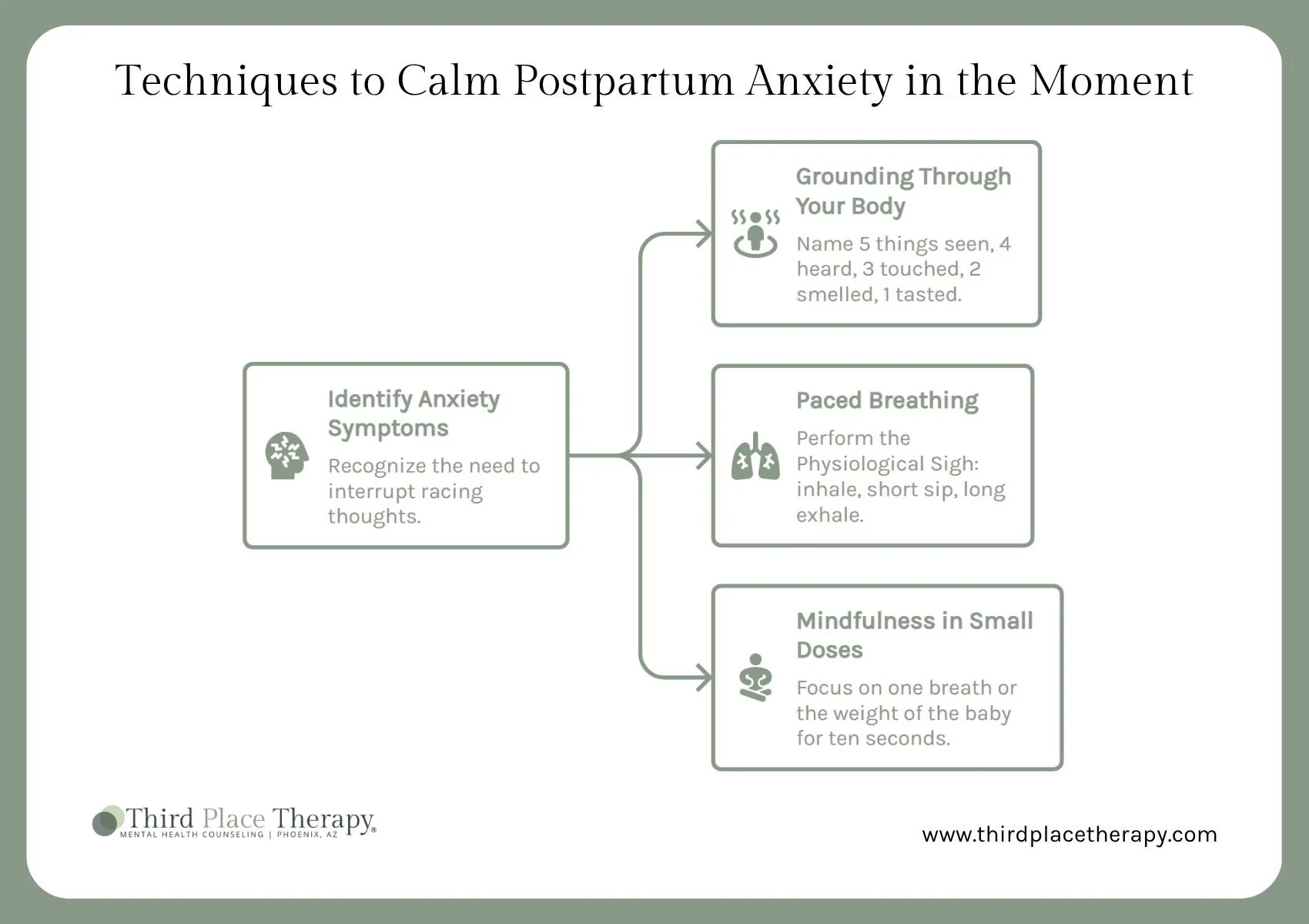
These aren't meant to fix everything. They're meant to interrupt anxiety symptoms long enough for your body to remember it's safe right now.
Grounding Through Your Body
When your mind is racing, your body is usually the faster way back. Try naming five things you can see, four you can hear, three you can touch, two you can smell, and one you can taste. It sounds almost too simple to work. It works because it forces your attention out of the loop and into the room you're actually standing in.
Paced Breathing (the Physiological Sigh)
Take a normal breath in through your nose, then a second short sip of air on top of it, then a long, slow exhale through your mouth. One or two rounds of this can signal to your nervous system that the danger has passed, even before your thoughts catch up. It's the kind of thing you can do while bouncing a baby on your hip, which matters, because most postpartum coping tools aren't actually doable one-handed.
Mindfulness in Small, Realistic Doses
Nobody with a newborn is sitting down for a 20-minute meditation. That's fine. A pilot study on mindfulness during the perinatal period found that 75% of participants experienced a decrease in stress symptoms, and the sessions weren't marathons. Mindfulness here can be one full, slow breath while you breastfeed or bottle-feed your baby. It can be noticing the actual weight and warmth of them in your arms for ten seconds before your mind pulls you back into the what-ifs. Small doses, repeated often, add up.
What About Postpartum Intrusive Thoughts?
If part of what's happening involves sudden, unwanted images of something bad happening to your baby, we want you to hear this clearly: that does not make you a dangerous parent. Intrusive thoughts associated with postpartum anxiety are common, and the distress you feel about them is actually a sign of how much you care, not evidence against you.
The short version of what helps: name the thought without arguing with it ("there's that thought again") rather than trying to prove it wrong or push it away. Pushing tends to make thoughts louder, not quieter. We've written a full, dedicated guide on intrusive thoughts if you want to go deeper into why they happen and what helps long-term.
If your thoughts ever feel unsafe or like more than you can carry, please reach out right now:
988 Suicide & Crisis Lifeline: call or text 988, free and confidential, available 24/7
Postpartum Support International Helpline, 1-800-944-4773 (call or text)
How long does postpartum anxiety usually last?
There's no single timeline. For some, it eases within weeks as sleep and hormones stabilize. For others, without support, it can persist for months. Treatment tends to shorten the timeline considerably either way.
Cognitive Tools That Actually Help
This is where CBT earns its reputation. A study of a 6-week CBT-based program for pregnant women with mild anxiety found that it reduced the risk of postpartum depression and anxiety by about 80%, which is a genuinely striking number for something this brief.
Naming the Thought Instead of Fighting It
When a worry spikes, try labeling it out loud or in your head: "I'm having an anxious thought about the baby's breathing." That small shift, from being inside the thought to observing it, creates just enough distance for you to choose your next move instead of getting swept along.
Questioning the Story, Not the Feeling
The feeling is real. The story attached to it isn't always accurate. Ask yourself: what's the actual evidence for this fear right now, in this room? Not "could this theoretically happen someday," but right now. Anxiety loves hypotheticals. Present-moment evidence is usually much less dramatic than the spiral.
Can postpartum anxiety go away without treatment?
Sometimes mild symptoms ease on their own as things settle. But for many people, it lingers or worsens without support, so waiting it out isn't always the gentler option it seems like.
The Partner's Role: What Support Actually Looks Like
"Let me know if you need anything" is well-meant and mostly useless, because anxiety makes it hard to identify what you need, let alone ask for it. In that same CBT research, the piece that mattered most wasn't the coping skills themselves. Improvements in social support were the strongest predictor of reduced anxiety. Support is not a nice extra. It's part of the treatment.
For a partner or co-parent, useful support tends to look like specific offers instead of open-ended ones:
"I've got the baby for the next hour, go do whatever helps you reset" instead of "let me know if you need a break"
Noticing the checking behaviors (repeatedly testing the baby monitor, re-checking locks) and gently naming them without shame
Going to an appointment together, or at least asking afterward what the provider actually said
Learning the difference between reassurance that helps and reassurance that just feeds the loop
If you're the partner reading this, your own anxiety counts too. We've written more about that in our piece on postpartum depression and anxiety in dads and non-birthing partners.
IIf this is bigger than one person can carry alone, our perinatal mental health therapy looks at the whole picture: you, your baby, and the people supporting you.
Book a free 15-minute consultationWhat is the best coping mechanism for postpartum anxiety?
There isn't one best tool because anxiety shows up differently for everyone. A combination tends to work better than any single trick: body-based grounding for acute moments, cognitive tools like naming the thought for recurring worries, and real social support underneath all of it.
How Do You Advocate for Yourself at a Medical Appointment?
Here's something that isn't talked about enough: despite ACOG guidelines recommending routine screening, a recent study found most pregnant and postpartum patients received no formal mental health screening at all. The standard questionnaire at your postpartum visit is often built to catch depression, not anxiety, so you can walk out with a clean bill of health while still lying awake every night checking that your baby is breathing.
That means the appointment usually goes better if you come in ready to say more than "I'm fine, just tired." Try something like:
"I'm not sad, but I can't turn my worry off, even when the baby's asleep, and I could rest."
"I'm having thoughts about my baby's safety that show up on their own, and I can't stop them."
"My heart races and my body feels tense a lot of the day, not just when something's actually wrong."
You're allowed to ask directly: "Can we talk about anxiety specifically, not just depression?" You know your own experience better than a ten-question form does.
What Does a Realistic Recovery Timeline Look Like?
We wish we could give you a number. The honest answer is that it varies. Some parents feel noticeably steadier within a few weeks of using these tools consistently. Others need longer, especially if there's a history of anxiety, a difficult birth, or very little support at home. Neither pace is a failure.
What we can tell you is that waiting it out alone tends to take longer than getting support early. Anxiety that's addressed tends to shorten its own timeline. Trying to white-knuckle your way through anxiety alone tends to make it last longer.
When Should You Reach Out for Support?
Self-help strategies genuinely help, and they also have a ceiling. If the worry is constant, physical, interfering with sleep or bonding, or lasting more than a couple of weeks without easing, that's the point where working with a postpartum anxiety therapist tends to make a meaningful difference.
Joining a support group through Postpartum Support International can also help, especially with the isolation that so often comes with this. If you want a broader toolkit beyond the postpartum-specific tools here, our guide on coping skills for anxiety covers more general approaches that pair well with these.
At Third Place Therapy, we know postpartum anxiety isn't a character flaw, and it isn't something you're supposed to white-knuckle through alone. Our PMH-C-certified mental health professionals offer trauma-informed care in Phoenix and telehealth across Arizona. When you're ready, we're here. Get in touch.
