
Postpartum Anxiety Symptoms: A Guide for New Parents and Partners
You held your baby today. You also lay awake at 3 a.m. running a loop of everything that could go wrong. Both of those are true, and they can sit right next to each other without either one canceling the other out.
If your thoughts feel like they're racing, if a low hum of dread follows you from room to room, if your body won't settle even when your baby finally sleeps, that's not a character flaw, and it isn't "just new-parent nerves." It's common, it's real, and it has a name.
We wrote this guide for the birthing parent who is outwardly fine and privately overwhelmed. We wrote it for the non-birthing partner reading late at night, wondering if what they're feeling counts. And we wrote it for anyone holding a new parent close and trying to help. Wherever you land, you're welcome here.
Here's what we'll walk through together:
The full range of postpartum anxiety symptoms, including the ones most guides skip
How postpartum anxiety differs from postpartum depression and the baby blues
When symptoms can start and how they shift across the first year
What causes postpartum anxiety
How it shows up in fathers and non-birthing partners
How anxiety can affect bonding, and why that's not the end of the story
Self-screening tools you can use at home
When to reach out for support
Intrusive thoughts, postpartum OCD, and crisis resources
Answers to the questions parents ask us most
The Full Range of Postpartum Anxiety Symptoms
Postpartum anxiety is persistent, excessive worry, often about the baby's health and safety, that lingers after childbirth and interferes with daily life, sleep, or your ability to rest even when you have the chance.
It's a real mental health condition, not a character flaw. Most guides list only the obvious signs. We want to start with the whole spectrum, because recognizing yourself is often the first relief.
You're not alone in this, and the numbers back that up. Research suggests that about 1 in 5 women meet criteria for an anxiety disorder during pregnancy or the postpartum period, a pooled prevalence of 20.7%. That's context, not a scare, just proof you're in good company.
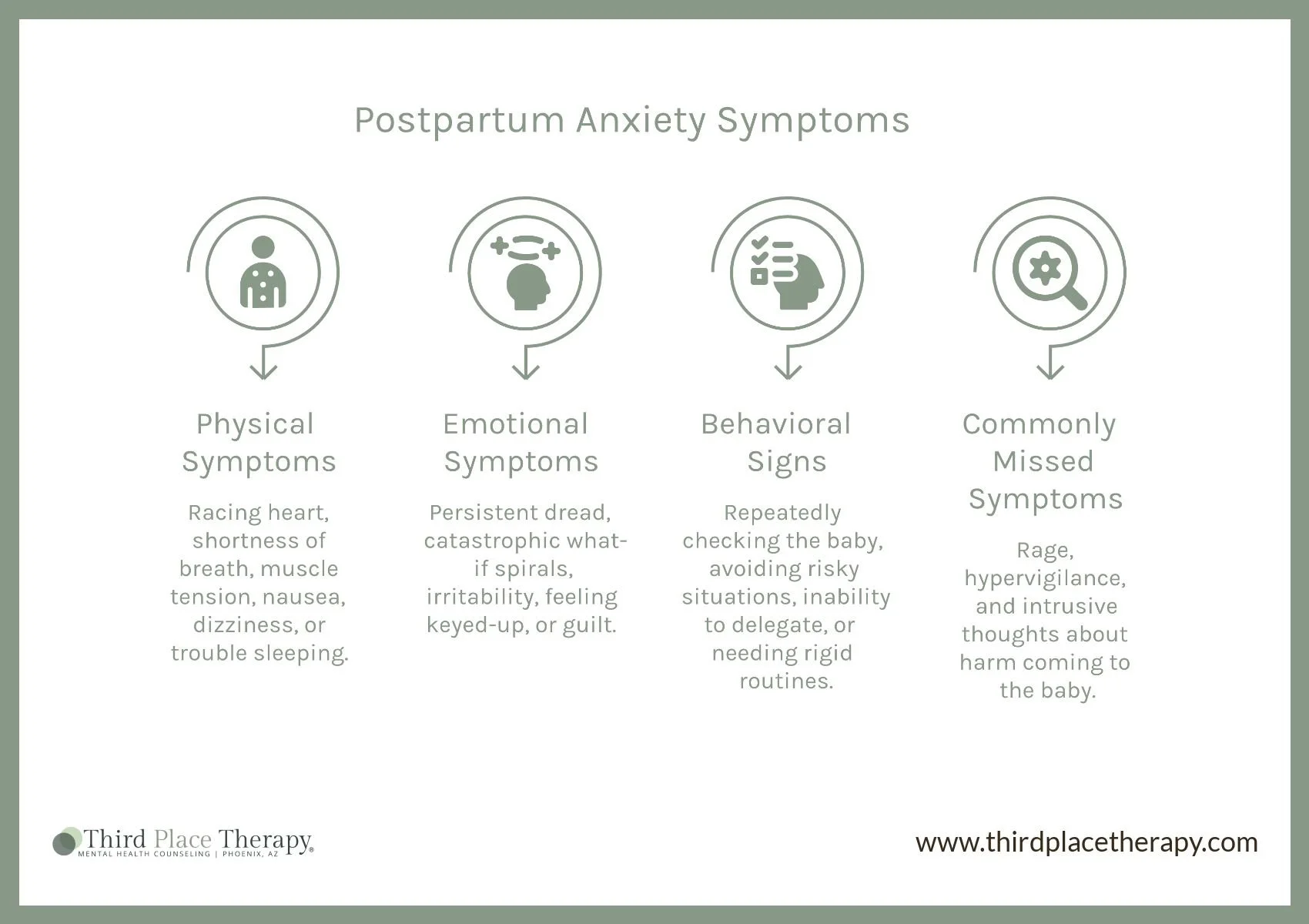
Symptoms tend to cluster into three groups: physical, emotional, and behavioral, plus a set of commonly missed signs we'll cover last.
Postpartum Anxiety Physical Symptoms
Anxiety lives in the body as much as the mind. Physical symptoms often include:
A racing heart or palpitations
Shortness of breath
Muscle tension, clenching, or headaches
Nausea or a churning stomach
Dizziness or feeling shaky
Trouble sleeping even when the baby is sleeping
These sensations can mimic a panic attack or feel like a medical emergency. If your body has ever convinced you something is deeply wrong when a check-up says otherwise, that's disorienting, not dramatic. It's your nervous system stuck in the "on" position.
Racing Thoughts and Emotional Symptoms
Emotionally, postpartum anxiety can feel like your mind won't power down. You might notice:
A persistent sense of dread, like something bad is about to happen
Catastrophic "what if" spirals about your baby's safety
Irritability or a short fuse
Feeling keyed-up, restless, or unable to relax
Guilt for feeling anxious at all
Racing thoughts are their own experience: looping, repetitive, hard to interrupt. Everyday worry comes and goes with ordinary stress for most people, but here it circles back on itself, playing the same frightening scene on repeat no matter how many times you reassure yourself. Naming that difference matters.
Behavioral Signs: Checking, Avoiding, Controlling
Anxiety also shapes what you do. Behavioral signs of postpartum anxiety can look like:
Repeatedly checking the baby's breathing, temperature, or the locks on the door
Avoiding situations that feel risky: outings, visitors, driving
Finding it almost impossible to delegate baby care to anyone else
Needing routines to run exactly, tightly, your way
Try to hear this gently: these aren't signs you're controlling or overprotective. They're your mind's attempt to manage fear, the only way it knows how. The behavior is the smoke, not the fire.
Commonly Missed Symptoms: Rage, Hypervigilance, and Intrusive Thoughts
Some of the most disorienting symptoms are the ones nobody warns you about. Maybe you snapped at your partner over an unloaded dishwasher, and the size of your reaction scared you. Maybe the house is quiet and calm, and you still feel on edge, scanning the room for a danger you can't name.
That's rage and hypervigilance, both common, both easy to mistake for "I'm just a bad-tempered, anxious person now." You're not. This anxiety may simply be wearing a different outfit.
And then there are intrusive thoughts: sudden, unwanted, often frightening images or "what ifs" about harm coming to your baby. In a recent postpartum study, 95.8% of participants reported unwanted thoughts of accidental harm and 53.9% reported unwanted thoughts of intentional harm; most participants experienced a reduction or resolution of these thoughts by six months postpartum.
When these thoughts pair with checking or mental rituals, the presentation can overlap with what's sometimes called postpartum OCD, but noticing that overlap isn't the same as a diagnosis.
If your thoughts ever feel unsafe or overwhelming, please reach out right now:
988 Suicide & Crisis Lifeline, call or text 988, free and confidential, available 24/7
Postpartum Support International Helpline, 1-800-944-4773 (call or text). Free and confidential; note this is not a crisis line, so messages are returned by trained volunteers within helpline hours (8 a.m.-11 p.m. EST). In an emergency, use 988.
What are the common symptoms of anxiety after childbirth?
The common symptoms of postpartum anxiety fall into three groups: physical (racing heart, shortness of breath, muscle tension, nausea, "tired but wired" sleeplessness), emotional (persistent dread, racing "what if" thoughts, irritability, guilt), and behavioral (repeated checking, avoidance, difficulty delegating baby care). Commonly missed signs include rage, hypervigilance, and intrusive thoughts.
Postpartum Anxiety vs. Postpartum Depression: What's the Difference
Postpartum anxiety and postpartum depression often travel together, share many of the same risk factors, and still feel different day to day. Anxiety tends to feel "wired," restless, racing, on high alert. Depression tends to feel "heavy" or numb, flat, hopeless, disconnected. Many parents live with both of these mood and anxiety disorders at once, and both can be true.
There's also a third, milder category worth naming so it doesn't get confused with either: the baby blues, a brief, common wave of tearfulness and mood swings in the first days after birth that usually lifts on its own.
Here's a quick way to hold the difference between postpartum anxiety, postpartum depression, and the baby blues side by side:
| Baby Blues | Postpartum Anxiety | Postpartum Depression | |
|---|---|---|---|
| Core feeling | Tearful, mood swings, weepy | Wired, worried, on alert | Heavy, numb, hopeless |
| Typical duration | Days; resolves on its own | Persists without support | Persists without support |
| Key symptoms | Crying, irritability, overwhelm | Racing thoughts, dread, checking, physical tension | Sadness, loss of interest, guilt, low energy |
| When it usually starts | First few days after birth | Pregnancy through the first year | Pregnancy through the first year |
| When to seek support | If it lasts beyond ~2 weeks | When it's frequent, intense, or interfering | When it's frequent, intense, or interfering |
When Postpartum Anxiety Starts, and How It Changes Across the First Year
Here's a quiet myth worth dismantling: anxiety doesn't only begin after delivery. It can start during pregnancy, which is sometimes called perinatal onset, and many parents don't realize this, so they blame themselves for "not bouncing back" from something that actually began months earlier. About half of parents who experience perinatal depression or anxiety report symptoms beginning during pregnancy.
And there's no expiration date on this. Symptoms can persist or resurface well past the "fourth trimester." One large U.S. study found that the majority of new-onset postpartum anxiety diagnoses occurred between one month and one year after childbirth, not in the first few weeks.
Anxiety can persist or recur beyond the first year, especially when new stressors or developmental changes arise. However, symptoms beginning well after the postpartum period may also reflect generalized anxiety, OCD, trauma-related symptoms, or another condition, so a clinician can help clarify the picture.
How Symptoms Can Evolve Across the First Year
This is a pattern, not a rigid timeline; every parent's arc looks a little different. But it can help to know that shifting symptoms are normal:
Early weeks: survival-mode hypervigilance and "tired but wired" sleep disruption. You're exhausted, but your body won't let you rest.
Months 2-6: checking routines settle into place, and return-to-work anxiety can spike as you hand your baby to someone else's care.
Months 6-12: weaning and new mobility milestones (crawling, cruising, climbing) can trigger a fresh wave of safety fears.
If your anxiety seems to fade and then return with a new trigger, that doesn't mean you're back at square one. It means you're a parent whose worries are moving as your child grows.
What Causes Postpartum Anxiety
There's rarely a single cause. More often, several things stack up at once:
Steep hormonal shifts after birth
Sleep deprivation
A personal history of anxiety, trauma, or a mood and anxiety disorder
Birth complications or a frightening delivery
Limited support at home
The sheer cognitive load of keeping a tiny human alive
These are risk factors, not guarantees. Plenty of parents with no prior history of anxiety develop a postpartum anxiety disorder anyway, and that doesn't mean anyone missed a warning sign. Sometimes it just happens.
So how do you tell postpartum anxiety from ordinary new-parent worry? The differentiators are frequency, intensity, and interference. Occasional worry is expected. When the worry is nearly constant, feels impossible to control, and gets in the way of sleep, relationships, or daily functioning, it's worth a closer look.
What are some natural remedies for postpartum anxiety?
Protecting sleep where you can, gentle movement, and leaning on peer support, including groups through Postpartum Support International, can genuinely help take the edge off. Think of these as supportive, not a substitute for professional care when symptoms are significant. If the worry is frequent and interfering, self-care and treatment work best side by side.
Postpartum Anxiety in Fathers and Non-Birthing Partners
Postpartum anxiety isn't only a birthing-parent experience. Fathers and non-birthing partners live it too, and it often goes unrecognized, because screening and cultural attention around maternal mental health center almost entirely on the person who gave birth.
It can also look different. Instead of visible worry, it may show up as irritability, withdrawal, throwing oneself into work, or hypervigilance about finances and safety, which is easy to wave off as "just stress."
The research is sobering: the prevalence of postpartum anxiety in men is estimated at around 10%, roughly on par with paternal postpartum depression. And depression and anxiety in fathers frequently go undiagnosed and untreated, partly because of stigma and reluctance to ask for help.
If you're the partner reading this and quietly recognizing yourself: your symptoms count. You don't have to earn support by struggling more than someone else. For a deeper look, we've written about postpartum depression in men and non-birthing partners.
How Postpartum Anxiety Can Affect Bonding, and Why That's Not the End of the Story
Anxiety can make bonding feel harder. Hypervigilance keeps you braced for danger instead of present for the sweet, ordinary moments. Intrusive thoughts can make you second-guess yourself. Some parents feel a distance they didn't expect, and then feel guilty for feeling it.
Here's the part we never want you to miss: bonding isn't a single, fixed event you either nail or fail. It's a relationship that deepens over time, across thousands of ordinary moments. Struggling to feel connected right now doesn't predict the relationship you'll have with your child.
And support helps, reliably. When a parent gets care for postpartum anxiety, both their own experience and the parent-child relationship tend to improve together. You don't have to white-knuckle this alone.
Self-Screening Tools You Can Use at Home
Sometimes it helps to have something concrete to hold. Two free, validated self-report tools can give you a starting point:
The GAD-7, a short, seven-question screen for generalized anxiety. Not a diagnosis, just a snapshot of how much worry has been showing up over the past two weeks.
The Edinburgh Postnatal Depression Scale (EPDS), a widely used 10-item questionnaire designed for the perinatal period. It's widely available at no cost and includes questions that also capture anxiety.
One important caveat: these tools flag risk and open a conversation. They don't diagnose you, and a "low" score doesn't invalidate very real distress. If your number comes back low but your gut says something's off, trust yourself. You're the expert on you. Use a screening result the way it's meant to be used: as a reason to reach out, not a pass/fail test.
What is delayed postpartum anxiety, and how can it be treated?
Delayed postpartum anxiety simply means symptoms that emerge or intensify later in the first year (or beyond) rather than right after birth. The good news: treatment is the same regardless of when symptoms start, often a mix of skills-based approaches like cognitive behavioral therapy, processing what's underneath the worry, and support tailored to your life.
When to Reach Out for Postpartum Anxiety Treatment
Here's a low-pressure way to think about it. If your symptoms are frequent, intense, lasting more than two weeks, or getting in the way of your sleep, your relationships, or your daily life, it's worth a conversation with a professional. You don't have to be in crisis to deserve support.
Something can hold people back here. Many of us were raised to believe that good parents don't struggle, that needing help means we're doing it wrong. That silence is incredibly common, and it's not a personal failure. It's a story a lot of us absorbed without ever agreeing to it.
Therapy for postpartum anxiety isn't what people fear. It's practical and collaborative, not about "fixing" you, because you're not broken. It's about building skills that help you reduce anxiety and gently process what's underneath it, at your pace.
When you're ready, our PMH-C certified postpartum anxiety therapists offer care via telehealth across Arizona. No pressure, just a conversation. If you'd like the broader picture, you can also learn about our approach to perinatal mental health.
You're Not Meant to Do This Alone
You show up for every feeding, every diaper change, every 3 a.m. wake-up. You've also had thoughts that scared you, ones you haven't said out loud. Neither cancels out the other. You're still doing this right.
Everything you're feeling is common, it's treatable, and it says nothing about your capacity to love and care for your child or your partner. Dealing with postpartum anxiety isn't a test of your strength. Reaching out is.
When you're ready, we'd be honored to be your first low-pressure step. Third Place Therapy is Phoenix-based with telehealth across Arizona, and our PMH-C certified therapists specialize in this exact terrain. We're a private-pay practice, and we'll always be transparent with you about cost. You can reach out here or learn more about working with a postpartum anxiety therapist.
Whether you're the parent who gave birth or the partner reading over their shoulder, you're allowed to want support. And you don't have to carry this alone. Reach out!
