
Is Postpartum Anxiety Normal? Signs It's More Than New-Parent Worry
Yes. Some worry after a new baby arrives is completely normal. Your nervous system is doing exactly what it was built to do, which is keep a small, vulnerable person alive. If you're lying awake replaying a hundred what-ifs, we want you to hear this first: you are not broken, and you are not alone in this.
And also, sometimes worry grows past the point of being helpful. It stops being a background hum and becomes the whole song. When that happens, it has a name: a maternal mental health condition worth understanding, not fearing. And it responds beautifully to support. Both of those things are true at once, and holding them together is the whole point of this article.
Postpartum anxiety is more common than most people realize. A systematic review and meta-analysis in the British Journal of Psychiatry found that about 15% of people experience anxiety symptoms in the first six months after giving birth — roughly one in seven. When we say "new parent" here, we mean all of you: birthing parents, non-birthing partners, adoptive and LGBTQ+ families, and parents who are chestfeeding, breastfeeding, or formula-feeding alike.
Here's what we'll walk through together:
How common postpartum anxiety really is
The line between normal new-parent worry and a postpartum anxiety disorder (with a side-by-side comparison)
Lesser-known signs, including rage, insomnia, and feeding fears
Postpartum anxiety and breastfeeding or chestfeeding
Postpartum anxiety and sleep
What causes postpartum anxiety, briefly
A gentle, practical when-to-seek-help framework
How Common Is Postpartum Anxiety, Really?
Common enough that if you're reading this, you're in good company. That same review put the rate of a diagnosable anxiety disorder in the months after birth at 9.9%, with anxiety symptoms more broadly at 15.0%. Other research lands higher still. A study in the Journal of Affective Disorders found anxiety disorders in 17.1% of women in the early postpartum period, notably more prevalent than postpartum depression at 4.8%.
Perinatal anxiety affects partners and co-parents as well. A systematic review estimated that approximately 5%–15% of fathers experience perinatal anxiety, which is one reason we never assume this is a mothers-only experience.
So why does it feel less talked about than postpartum depression? Partly because it's under-recognized. There is no standalone DSM diagnosis called “postpartum anxiety disorder.” Anxiety during pregnancy or after birth is generally diagnosed using the criteria for the relevant anxiety disorder, with the timing and perinatal context documented separately. This does not mean that postpartum anxiety is simply a symptom of postpartum depression; anxiety can occur on its own or alongside depression.
Normal New-Parent Worry vs. Postpartum Anxiety Disorder
Worry itself isn't the problem. Worry is adaptive. Caring for a new baby means a certain amount of vigilance is not only expected; it's protective. The question is never "Am I worried?" It's about the degree, duration, and how much the worry is running your day.
Here's the difference, side by side:
| Dimension | Normal new-parent worry | Postpartum anxiety |
|---|---|---|
| Frequency & intensity | Comes and goes; rises with a specific concern, then settles | Near-constant; a steady background dread that's hard to switch off |
| Duration | Eases over days or weeks as you find your footing | Persists for weeks or months without easing on its own |
| Physical symptoms | Occasional restlessness or a racing heart in a scary moment | Frequent physical symptoms: racing heart, nausea, tension, panic attacks, feeling on edge |
| Effect on sleep & eating | Tired from the newborn schedule, but able to rest and eat when you can | Can't sleep even when baby sleeps; appetite disrupted by worry |
| Response to reassurance | Reassurance and time help; you can be redirected | Reassurance doesn't stick; the worry snaps right back |
A plain-language rule of thumb: if worry is constant, physical, and doesn't ease with reassurance or time, that's the line into clinical territory. Crossing it doesn't mean you've failed. It means the caring part of you got stuck in the "on" position and could use some help settling.
How long does postpartum anxiety usually last?
It varies from person to person. For some, worry eases over a few weeks as they find their rhythm. For others, without support, it can persist for months and stretch into the first year. There's no fixed timeline, and having one doesn't mean you have to white-knuckle through it alone. Support tends to shorten the road.
Signs of Postpartum Anxiety Beyond "Just Worrying"
Postpartum anxiety doesn't always look like worrying. It often wears disguises that new parents don't connect to anxiety at all. We'll keep this at a recognition level; our companion guide to the full range of postpartum anxiety symptoms covers the fuller breakdown across physical, emotional, and behavioral categories.
A few of the less-obvious signs worth naming:
Rage and irritability. Sudden anger that feels bigger than the moment, snapping, seething, a short fuse that isn't like you. Anxiety and anger share the same wiring, and postpartum rage is one of the most under-discussed faces of it.
Insomnia. Not the "up every three hours" kind, but the "wide awake even when I could sleep" kind. More on this below.
Intrusive worry about feeding. Circling thoughts about ounces, latch, or weight gain that won't quiet down.
Hypervigilance around the baby's safety. Checking breathing over and over, a hard time letting anyone else hold the baby, catastrophic mental movies about worst-case scenarios.
One quick distinction: postpartum anxiety is not the same as postpartum OCD, which involves unwanted, intrusive thoughts paired with compulsions or rituals meant to neutralize them. If your worries take the shape of disturbing images you desperately don't want, that's worth naming to a provider. It's more common than people admit, and it's very treatable.
Postpartum Anxiety and Breastfeeding or Chestfeeding
Feeding is where a lot of postpartum anxiety quietly concentrates, and it deserves its own name. For many parents, the worry organizes itself entirely around one question: is my baby getting enough?
It can show up as a persistent fear of not producing enough milk, anxiety around latch or weight gain, or hypervigilant tracking of every feed, every ounce, every minute at the breast. This affects parents who breastfeed and chestfeed, and it can show up just as loudly as guilt or anxiety in parents who are formula-feeding or supplementing, who often carry a private ache about whether they're doing it "right."
There's also a loop worth understanding. Anxiety can interfere with let-down and make the whole feeding experience feel harder. That, in turn, can feed more anxiety. If you've noticed that, please hear us: that loop is common, and it is not a personal failure. It's your nervous system reacting to pressure, not a verdict on your body or your love.
This is exactly the kind of adjustment we sit with parents through. As postpartum anxiety therapists, we help new parents untangle feeding-related worry and the broader storm of early parenthood, gently, at your pace, with your sense of safety as the priority.
How much anxiety is normal postpartum?
Some worry is expected in the early weeks: it's your protective instincts coming online. It becomes a concern when it's constant rather than occasional, physical rather than just mental, and doesn't ease with reassurance or time. If you're unsure, the comparison earlier in this article is a good gut check.
Postpartum Anxiety and Sleep: Why You Can't Rest Even When Baby Does
Every new parent is tired. That's not what we're talking about here. Postpartum anxiety-driven insomnia is something more specific: the inability to sleep even during the windows when the baby is asleep and rest is genuinely possible.
The mechanism is hyperarousal. Your body stays switched on, listening for a cry, running mental checklists, replaying the day, long past the point of physical exhaustion. In one study of postpartum sleep, experts and patients described a distinct psychological domain that included maternal worry and ‘a state of increased vigilance overnight. In other words, the nervous system is standing guard when it could be resting.
This matters because sleep loss and anxiety reinforce each other. Research has found that poor sleep quality is significantly associated with greater symptoms of both depression and anxiety in postpartum women.
So the pattern of lying awake while the house is quiet isn't just frustrating; it's a signal worth naming to a provider, because it's one of the clearest tells that worry has tipped past ordinary tiredness.
What Causes Postpartum Anxiety?
There's rarely a single cause. More often, several things stack up at once during one of the most demanding transitions a body and mind can go through. We'll keep this brief and mechanism-focused rather than exhaustive.
Hormonal shifts. The steep drop in reproductive hormones after giving birth can leave the nervous system more reactive.
Sleep deprivation. Chronic short sleep lowers the threshold for anxiety and makes the body harder to soothe.
Personal or family history. A prior anxiety disorder or a family history is one of the more consistent risk factors.
Birth experience or trauma. A frightening, painful, or out-of-control birth can leave the body bracing long after the delivery is over.
When Worry Crosses the Line: A When-to-Seek-Help Framework
This isn't a diagnostic test, and it can't tell you what's "wrong." Think of it instead as a few honest questions to sit with. If you find yourself answering these in the harder direction, that's simply useful information, a nudge to reach out, not a mark against you.
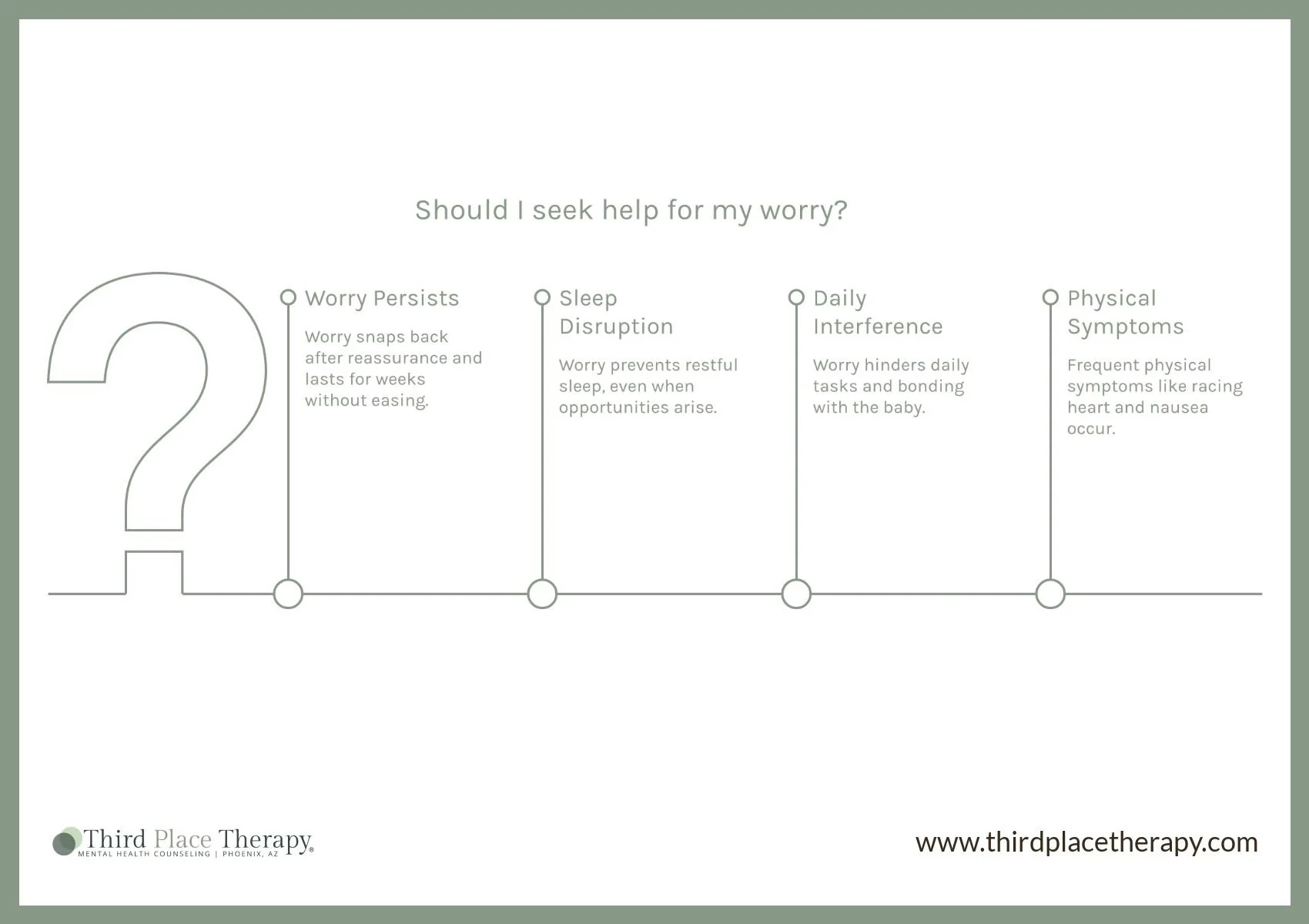
Does the worry ease when someone reassures you, or does it snap right back?
Are you able to sleep when you finally get the chance?
Is the worry getting in the way of daily tasks or of bonding with your baby?
Are the physical symptoms (racing heart, tension, nausea) showing up often?
Has this been going on for weeks with no sign of easing?
Reaching out early is a sign of strength, not failure. Support doesn't require you to hit some threshold of "bad enough" first. It can look like a conversation with your OB or primary care provider, or working with a therapist who understands perinatal mental health. The point isn't to fix you — you're not broken. It's to accompany you back toward feeling like yourself.
Does postpartum anxiety go away on its own?
For some, mild symptoms ease as sleep improves and hormones stabilize, usually within the first few months. But for many, postpartum anxiety lingers or worsens without support; it doesn't reliably resolve on its own, and waiting it out often means suffering longer than necessary. Treatment tends to shorten the timeline considerably.
You're Not Failing: You're Adjusting to One of Life's Biggest Changes
You don't have to earn rest by falling apart first. If the worry has been running the show, it's okay to hand some of it over to someone else for a while.
This applies whether you carried and gave birth to your baby, whether you're the non-birthing partner watching someone you love struggle, whether you built your family through adoption, or whether your family doesn't look like the one in the parenting pamphlets. Worry after a new baby is human. So is needing a hand with it.
If worry has started to feel like more than worry, we're here. At Third Place Therapy, our postpartum anxiety therapists offer trauma-informed, client-centered care, which simply means we make your sense of safety the priority and ask "What's happened to you?" instead of "What's wrong with you?" You can reach out to our postpartum anxiety therapists whenever you're ready.
