
If you're pregnant and feeling something other than pure happiness, what you're feeling is common. Mental health during pregnancy changes for a lot of people, and support is available at every stage.
You might feel thrilled at the ultrasound and then lie awake at 2 a.m. going over everything that could go wrong. You might snap at your partner over the dishes, or feel oddly flat when someone asks how you're doing. Feeling more than one thing at once is part of pregnancy. It doesn't mean you're doing it wrong.
Maternal mental health gets far less airtime than prenatal vitamins or birth plans. This guide is for anyone who is pregnant, whatever your gender or family structure, and for the non-birthing partners going through it alongside you. It covers what’s common, when it might be worth talking to someone, what prenatal therapy looks like, and how to bring it up with your OB or midwife.
How Pregnancy Affects Mental Health (and Why Maternal Mental Health Deserves Attention)
Mental health in pregnancy is shaped by several changes that hit at once. Hormones shift fast, sleep gets harder, and your body changes in ways you can't control. Your identity, your relationships, your work, and your finances can all feel unsettled. Any one of these can bring on worry, tears, irritability, or low mood, and they rarely show up one at a time.
Clinicians call this stretch the perinatal period: pregnancy and the months after birth. NAMI describes maternal mental health as "psychological well-being during pregnancy and up to 18-24 months after giving birth".
According to the Policy Center for Maternal Mental Health, maternal mental health conditions like postpartum depression "are the leading complication of childbirth, impacting 20% of U.S. women," and the range also includes anxiety, OCD, and bipolar disorder.
Mental Health During Pregnancy in the First Trimester: Why It Can Feel So Intense
The first trimester can feel like the heaviest stretch, and research on anxiety backs that up. The MGH Center for Women's Mental Health reports on a study where "the highest rates of GAD were observed in the first trimester." (GAD stands for generalized anxiety disorder, a pattern of ongoing, hard-to-control worry.) The Policy Center's 2025 fact sheet update notes that "20% of women experience maternal anxiety disorders, with the highest rates occurring during early pregnancy."
Part of it is physical. Your hormones are shifting quickly, and nausea and exhaustion leave you with very little in reserve. Part of it is uncertainty. A lot of people wait to share their news, so they carry big feelings without their usual support around them. If you haven't told anyone yet, you can still talk to someone. A therapist can be the first person you tell.
When Pregnancy Brings Up the Past: Childhood Trauma, Relationship Trauma, and Prior Loss
Pregnancy can stir up old worries as well as new ones: things from your childhood, a past relationship that didn't feel safe, or an earlier pregnancy loss or difficult birth.
Here's one way to make sense of it. Your nervous system keeps a record of times you felt unsafe, and it watches for anything that looks like them. Pregnancy brings plenty of possible reminders: medical exams, being touched, feeling exposed, losing control over your own body, and thinking about your own childhood while you picture your child's. Your body can react to these cues before your mind connects the dots. That's why dread, a racing heart, or sudden tears can show up for no obvious reason.
None of this means something is wrong with you. It's a response to what happened to you, and you can work with it. EMDR (Eye Movement Desensitization and Reprocessing) is a structured therapy that helps the brain process distressing memories so they feel less charged. Somatic therapy works through the body, helping you notice physical stress responses and settle them. If an earlier birth still feels present, our guide to birth trauma therapy explains how these approaches can help. It also says nothing about what kind of parent you'll be.
What are the common mental health issues during pregnancy?
Anxiety and depression are the most common mental health issues during pregnancy. Many people also have intrusive thoughts, OCD symptoms, or trauma responses tied to past experiences. These can show up in any trimester, and having one doesn't mean you'll have the others. If any of them last for weeks or get in the way of daily life, it's reasonable to talk to someone.
Common Mental Health Challenges During Pregnancy
Anxiety and depression are the most common mental health challenges during pregnancy, and many people also have intrusive thoughts or trauma responses. The table below lists what's common next to signs that it might be worth talking to someone. Use it as a starting point. It isn't a diagnosis.
| Experience | What's common in pregnancy | When it may be worth talking to someone |
|---|---|---|
| Mood swings | Tearful one hour, fine the next | Low or tense moods take up most of your days |
| Worry | Questions about the baby's health, birth, money | Worry won't ease, even after reassurance |
| Sleep changes | Waking from discomfort or bathroom trips | Your mind races and keeps you awake when you could sleep |
| Low mood or numbness | Flat days when you're exhausted | Feeling empty or disconnected for two weeks or more |
| Intrusive thoughts | A scary "what if" that passes | Thoughts that keep coming back and lead to avoiding or checking |
| Irritability or anger | Shorter patience when tired | Anger that feels out of character or hurts your relationships |
Anxiety During Pregnancy, Including the “High-Functioning” Kind, and How Pregnancy Anxiety Therapy Helps
Prenatal anxiety can look like racing thoughts at bedtime, searching symptoms online again and again, or a body that won't settle when nothing is wrong. Some people notice tight shoulders, a clenched jaw, or a stomach that's always in knots.
Then there's the high-functioning kind. You keep working, building the registry, answering every email, and telling everyone you're fine, while inside you're on edge most of the time. Coping well on the outside doesn't mean you don't deserve support.
Pregnancy anxiety therapy gives you a place to say your worries out loud without being judged, plus tools to calm your body when the worry hits. If the anxiety connects to past experiences, therapy can help with those roots too. Anxiety can also start or continue after birth, so support you build now can carry into the postpartum period.
Depression During Pregnancy, Sometimes Called Antepartum or Antenatal Depression
Antepartum depression, also called antenatal depression, is depression that happens during pregnancy. It can look like sadness or emptiness that doesn't lift, losing interest in things you used to enjoy, changes in sleep or appetite beyond the usual pregnancy changes, hopelessness, or trouble picturing the baby or feeling connected to the pregnancy.
Pregnancy doesn't protect anyone from depression, and low mood isn't a personal failing. If you get support during pregnancy, you'll already have someone in your corner if postpartum depression shows up later.
Prenatal OCD and Intrusive Thoughts
Lots of pregnant and postpartum people have unwanted, upsetting thoughts, like a sudden picture of something bad happening to the baby. If these thoughts horrify you, or you find yourself avoiding or checking things because of them, that shows they go against what you want. A thought is not the same as an intention.
When these thoughts take up a big part of your day, they can be part of prenatal OCD, and a therapist trained in perinatal mental health can help. You don't have to keep them secret. If you're ever in immediate danger, use the crisis resources in the next section.
IIf this is bigger than one person can carry alone, our perinatal mental health therapy looks at the whole picture: you, your baby, and the people supporting you.
Book a free 15-minute consultationWhen to See a Therapist During Pregnancy: Signs It's Time to Talk to Someone
It makes sense to see a therapist during pregnancy if your feelings last more than a couple of weeks, get in the way of sleep, work, or relationships, or feel too heavy to carry alone. You don't need to wait for a crisis. Signs it may be time include:
Worry that doesn't ease
Low mood or numbness most days
Dread about giving birth
Intrusive thoughts that keep coming back
Panic or a pounding heart that comes out of nowhere
Pulling away from people you care about
Old memories or feelings coming back up
A history of anxiety, depression, or loss
Some risk factors are good reasons to set up support early: past anxiety or depression, past trauma, a previous loss, little support at home, or a medically complicated pregnancy. They don't predict what will happen. They just mean a plan is worth having sooner.
Maybe you're thinking, "I'm managing, so it can't be that bad." That thought is common. You can be managing and struggling at the same time.
If you need help right now: If you're in crisis or having thoughts of harming yourself, call or text 988 or visit the 988 Suicide & Crisis Lifeline. For support at any hour, the National Maternal Mental Health Hotline at 1-833-TLC-MAMA (1-833-852-6262) is free, confidential, and available 24/7 in English and Spanish. Partners and family can call too.
How does pregnancy affect mental health?
Pregnancy affects mental health through fast hormone changes, poor sleep, physical discomfort, and big shifts in identity, relationships, and finances. It can also bring old experiences back up, like childhood trauma or a previous loss, because pregnancy and medical care can remind your nervous system of times you felt unsafe. Mixed feelings are a common result.
What Perinatal Mental Health Therapy Involves
Perinatal mental health therapy is therapy with someone who specializes in pregnancy and the postpartum period. They understand the emotions and the practical side too, from prenatal appointments to lost sleep. You can read more about our perinatal mental health therapy in Phoenix.
What Prenatal Therapy Sessions Look Like and What to Expect in the First Few Appointments
The first few prenatal therapy sessions are mostly about getting to know you. Your therapist will ask what brought you in, what support you have, and some of your history, at a pace you choose. Then you'll set goals together that make sense to you. You decide what to share and when.
Sessions happen in person in Phoenix or online anywhere in Arizona, so they can work around appointments, nausea, and low-energy days. You don't need a diagnosis, a crisis, or a clear-cut problem to start seeing a pregnancy therapist. "I don't feel like myself" is reason enough.
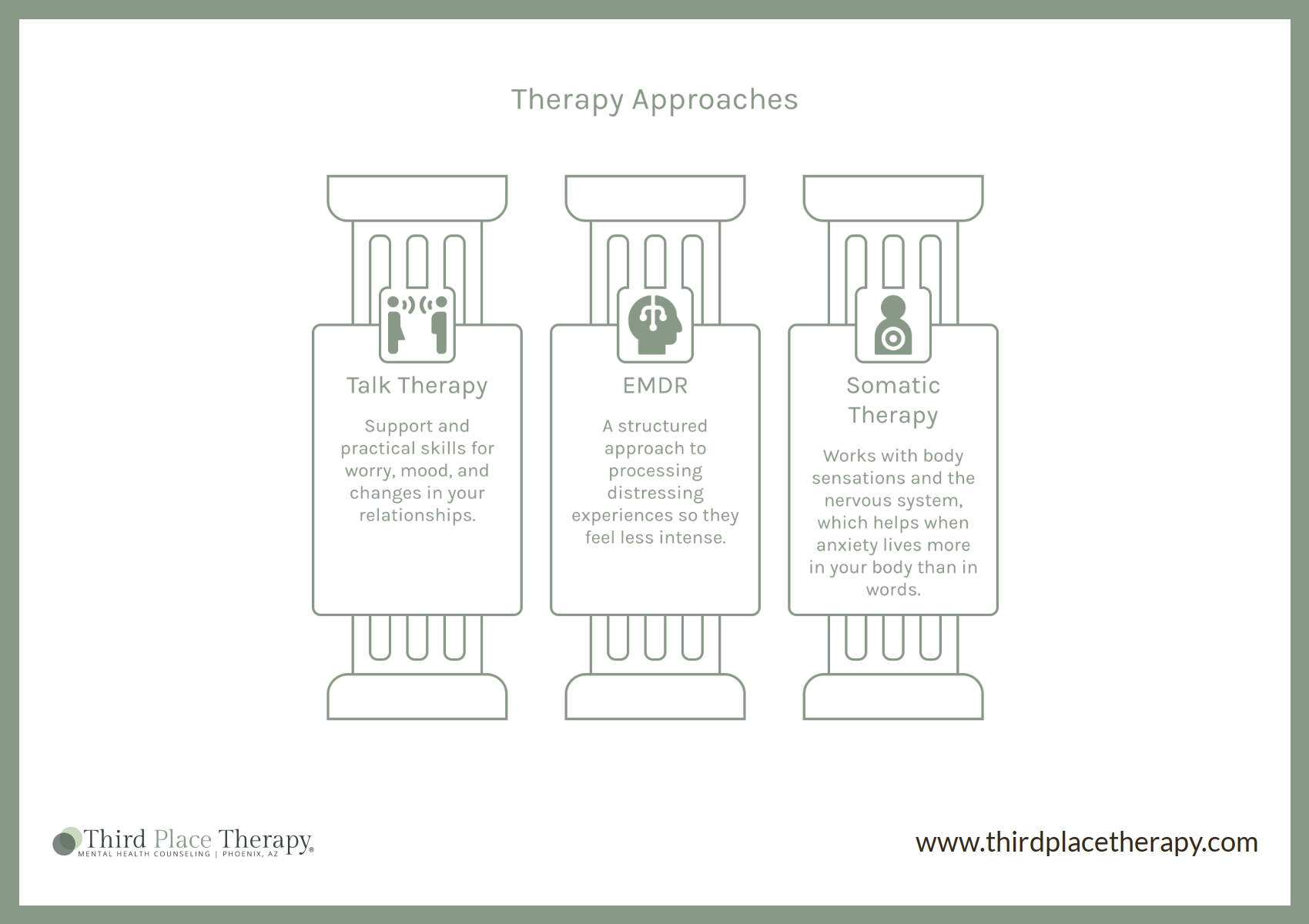
Therapy Approaches: Talk Therapy, EMDR, and Somatic Work
Talk therapy: support and practical skills for worry, mood, and changes in your relationships.
EMDR: a structured approach to processing distressing experiences so they feel less intense.
Somatic therapy: works with body sensations and the nervous system, which helps when anxiety lives more in your body than in words.
Elaine Evans, MS, LPC, our founder, is an EMDR-certified therapist, and our team includes clinicians with advanced training in Perinatal Mental Health. Our care is trauma-informed. That means your sense of safety comes first, and we ask "What happened to you?" rather than "What's wrong with you?"
Worried About "Opening Everything Up at Once"?
Therapy doesn't make you go through everything at once. Early sessions usually focus on steadiness: coping tools, sleep, and ways to calm your body. Deeper work comes when you feel ready, and you can slow down or pause at any point. Your pregnancy shapes the pace too, so your therapist plans around how you feel physically and how far along you are.
Mind-Body Support: Coping Strategies You Can Start Today
Small daily habits can support your mood alongside therapy. They're an add-on, not a replacement.
Keep a loose daily routine so your days have some structure.
Protect your sleep where you can, including rest during the day.
Move your body in ways your provider has approved.
Spend a few minutes outside each day.
Eat regular meals and snacks, even small ones.
Check in with one trusted person a few times a week.
Set limits on late-night scrolling through pregnancy forums.
Name what you feel, out loud or on paper.
Body-aware practices help when worry feels more physical than mental. Breathe in for four counts and out for six. A longer exhale can help your nervous system shift toward rest. Ground yourself by naming a few things you can see, hear, and touch. Notice where tension sits, maybe your jaw or shoulders, and let it soften as you breathe out. A two-minute body scan before bed can help too.
For Non-Birthing Partners: Mental Health When Someone You Love Is Pregnant
If you’re the non-birthing partner, your mental health matters here too. A meta-analysis across 21 countries, cited in a 2022 JAMA Network Open study, estimated that 9.76% of fathers experience depression during pregnancy. Partners often feel pressure to stay steady and put their own worries last, so it can show up as irritability, pulling away, constant worry about money or the birth, or feeling like a bystander in your own family.
You deserve support as well, and getting it helps the whole household. Our post on postpartum depression in men and non-birthing partners covers what to watch for. NAMI’s new parent guide is written for expecting and new parents of every kind, including non-birthing partners, and the hotline above takes calls from partners. Couples can also talk about it together: ask how the other person is really doing, and say out loud what you’re carrying.
How to Talk With Your OB or Midwife About Your Mental Health
Your OB or midwife is a good place to start, and they expect this conversation. The American College of Obstetricians and Gynecologists recommends screening for perinatal depression and anxiety "at the initial prenatal visit, later in pregnancy, and at postpartum visits." You can bring it up before they ask. Some ways to start:
"I've been feeling more anxious than I expected. Can we talk about it?"
"I'm having thoughts that scare me. Who can I talk to?"
"Can you refer me to a therapist who works with pregnancy?"
"What should I do if my mood changes after the baby comes?"
Jot down notes beforehand so you don't lose your words in the moment, bring your partner or another support person if that helps, and ask about a follow-up plan. Questions about medications during pregnancy belong with your OB or prescriber, who can walk through the options for your situation. Therapy and medical care can work side by side.
What are the symptoms of depression during pregnancy?
Symptoms of depression during pregnancy include sadness or emptiness that sticks around, losing interest in things you enjoy, hopelessness, pulling away from people, and trouble feeling connected to the pregnancy. Ordinary pregnancy tiredness tends to come and go. Depression tends to linger and color most of your day, even when you've rested. If that's been true for a couple of weeks, it's worth talking to someone.
You Don’t Have to Sort Through This Alone. Let’s Talk.
Pregnancy can hold excitement, worry, grief, and old memories all in the same week. None of that means you’re doing it wrong, and you don’t have to sort through it by yourself. Support can start now, long before the baby arrives, and it can include the person who is sharing this pregnancy with you.
At Third Place Therapy, we offer trauma-informed, perinatal-specialized therapy for pregnant people and their partners, including non-birthing partners. We start with what you need most, move at a pace that feels safe, and you decide what to share and when. Sessions are available in person in Phoenix and online across Arizona.
Ready to talk? Call us at (480) 418-6414 or send a message through the contact form on our website. You don’t need a diagnosis or a crisis to reach out. “I don’t feel like myself” is reason enough. To see how we work with pregnancy and the postpartum period, visit our page on perinatal mental health therapy in Phoenix.
